

What It Means When Your Engine Light Turned On Then Off
If your engine light turned on then off, here’s the short answer:
- The problem may not be gone. Your car’s computer stores a fault code even after the light disappears.
- The light turns off when the issue stops triggering the sensor — not because it’s fixed.
- Common causes include a loose gas cap, a failing oxygen sensor, spark plug issues, or a struggling catalytic converter.
- You should still get the car scanned for stored codes, even if the light is off now.
That little amber light appears on your dashboard. Your stomach drops. Then, a day later — it’s gone.
Did it fix itself? Did you imagine it?
You didn’t imagine it. And no, it almost certainly didn’t fix itself.
A check engine light that flickers on and off is your car’s way of flagging an intermittent fault — a problem that comes and goes depending on driving conditions, temperature, or how hard certain components are working. The light may go quiet, but the fault code stays stored in your vehicle’s computer, waiting to be read.
For a stressed parent trying to get the kids to school or make it to work on time, that blinking light is the last thing you need. The good news is that understanding what’s happening — and acting on it — is simpler than you might think.
I’m William Dickinson, webmaster for Bob’s Lil Car Hospital, and over more than 20 years of helping people make sense of complex automotive topics, I’ve seen countless drivers dismiss an engine light turned on then off as a fluke — only to face a much more significant repair later.
Engine light turned on then off glossary:
Why Your Engine Light Turned On Then Off
When an engine light turned on then off, it usually points to an intermittent fault. This means the onboard computer detected a problem that only occurs under specific conditions. Perhaps it only happens when the engine is cold. Maybe it triggers only during highway speeds or when the humidity is high.
Modern vehicles use “readiness monitors” to self-test various systems. Some monitors are continuous, running the entire time you drive. Others are non-continuous, meaning they only run when certain criteria are met. If a non-continuous monitor fails once but passes during the next three drive cycles, the computer may turn the light off.
However, the silence of the dashboard doesn’t mean the “ghost in the machine” has left. The problem is often just beginning to develop. Think of it like a smoke detector that chirps once and then stops. The battery is still low even if the noise ended.

At Bob’s Lil Car Hospital, we see this often in Southwest Washington and Rainer, OR. Drivers think they are in the clear, but the issue is simply “napping.” For more technical details, you can explore our category on engine diagnostics.
Common Triggers for an Engine Light Turned On Then Off
Several specific parts are notorious for causing that disappearing act. Understanding these can help lower your stress levels.
- Loose or Faulty Gas Cap: This is the most common culprit. A loose cap allows fuel vapors to escape. This triggers the evaporative emissions (EVAP) system. If you tighten the cap, the light may turn off after a few miles. Statistics show a faulty gas cap causes up to 30% of light activations.
- Oxygen (O2) Sensors: These sensors measure unburned oxygen in the exhaust. They often fail intermittently as they age. By 135,000 miles, they are very likely to cause a light to flicker on and off.
- Spark Plugs and Ignition Coils: A slight misfire might not be constant. It may only happen under heavy acceleration. This causes the light to pop up and then vanish when you return to a steady cruise.
- Mass Airflow (MAF) Sensor: If this sensor is dirty, it might send inconsistent data. This tricks the computer into thinking there is a major air-fuel imbalance.
If you drive a popular sedan, Decoding the Honda Accord Check Engine Light provides a great deep dive into these specific triggers.
The Role of the OBD-II System and History Codes
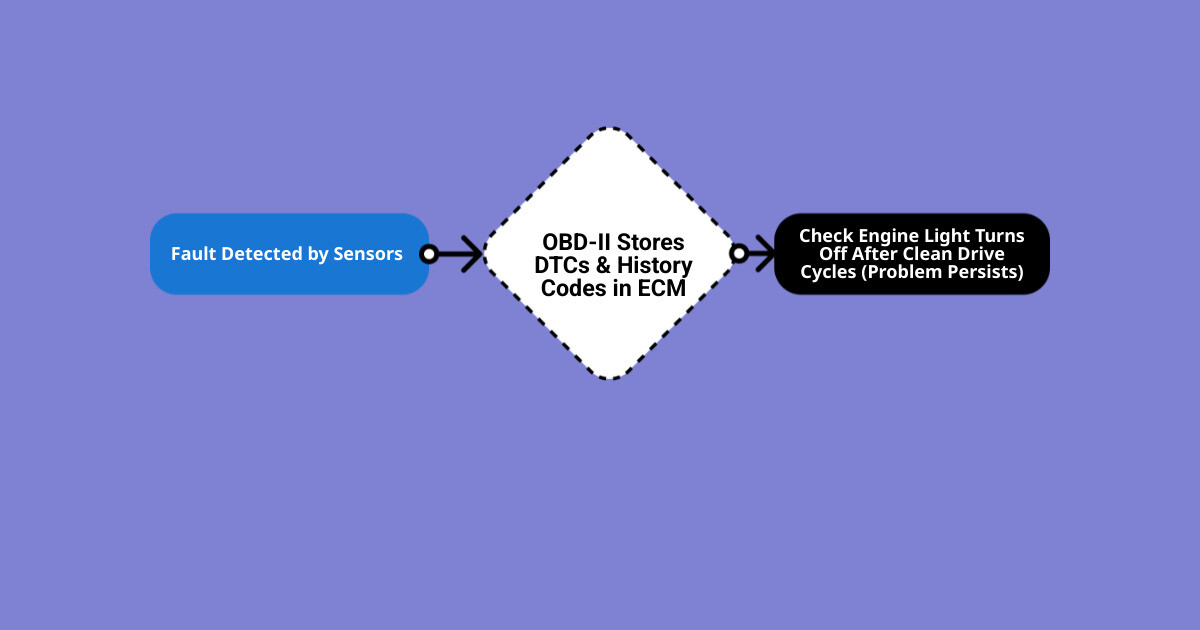
Your car has a brain called the Engine Control Module (ECM) or ECU. Since 1996, all cars use the OBD-II (On-Board Diagnostics) system. This system is like a black box for your car. Even when the engine light turned on then off, the “brain” remembers what happened.
When a sensor detects an anomaly, it creates a Diagnostic Trouble Code (DTC). If the problem persists, the light stays on. If the problem goes away, the light turns off, but the code is moved to “History” or “Pending” status.
Professional mechanics use high-end scanners to pull these history codes. This allows us to see exactly what the car was “feeling” when the light was on. It prevents us from guessing and helps us find the root cause before it leaves you stranded on the side of the road in Kelso or Longview.
For a broader look at how we pinpoint these issues, check out The Definitive Guide to Diagnosing Car Problems.
Safety First: Solid vs. Flashing Lights
It is vital to know the difference between a light that stays on and one that flashes. A solid light means “check this soon.” A flashing light means “stop now.”
A flashing check engine light usually indicates a severe engine misfire. This is dangerous because unburned fuel can enter the catalytic converter. This can cause the converter to overheat and potentially catch fire. Catalytic converters are complex components to replace and typically last about 130,000 miles.
If your light flickers on and off but remains solid when lit, you have time to drive to a shop. If it starts blinking like a strobe light, pull over safely. Continuing to drive risks permanent engine damage. You can read more about engine light meanings or consult this guide to check engine lights for further clarity.
What to Do When Your Engine Light Turned On Then Off
Don’t panic, but don’t ignore it either. Follow these steps to stay ahead of the problem:
- Check the Gas Cap: Ensure it is tight and the seal isn’t cracked. This is a simple fix that solves many issues.
- Observe Your Car: Listen for rough idling or hesitating. Note if the light comes on during specific events, like cold mornings in Castle Rock or Woodland.
- Use an OBD-II Scanner: You can buy a basic scanner or visit a local shop. Reading the code is the only way to know the truth.
- Complete a Drive Cycle: If you fixed something (like the gas cap), the car needs time to “re-learn” that the system is okay.
If you need to clear a persistent warning, our guide on Resetting Your Honda Accord’s Check Engine Warning offers practical steps.
Frequently Asked Questions about Intermittent Lights
Can a loose gas cap really cause the light to flicker?
Yes, absolutely. The EVAP system performs pressure tests at different times. If the cap is loose, the test fails and the light turns on. If you tighten it, the next test might pass, and the engine light turned on then off on its own.
Why does the light stay off for a few days then return?
This happens because of “non-continuous monitors.” Some tests only run when the fuel tank is between 1/4 and 3/4 full. Others only run when the engine reaches a specific temperature. The light returns once the computer attempts that specific test again and fails.
Does cold weather trigger the check engine light?
It can. Cold weather puts extra stress on batteries and sensors. A thermostat that is starting to fail might work fine in the summer but struggle to warm the engine properly in a Washington winter. This triggers a code that might disappear once the weather warms up.
Conclusion: Professional Care for Your Vehicle
At Bob’s Lil Car Hospital, we know that a dashboard light can ruin your day. Our team provides genuine care and professionalism to every driver from Kalama to Winlock. We treat your car like it’s our own, ensuring you leave with peace of mind.
An engine light turned on then off is a gift of time. It is a warning that something is starting to fail. Addressing it now prevents a major breakdown later. Stay updated with the latest on engine lights to keep your vehicle healthy.
If your light is playing hide-and-seek, don’t wait for it to stay on for good. Give us a call and ask a question today. We are here to help you stay on the road safely.