
Introduction: That Mysterious Check Engine Light
Car diagnostics is the process of using specialized tools to read data from your vehicle’s onboard computer systems to identify existing problems or potential issues before they become dangerous or expensive. Here’s what you need to know:
Quick Answer: What is a Car Diagnostic Test?
- What it does: Scans your vehicle’s computer systems and sensors for error codes (DTCs) that indicate malfunctions
- When you need it: When warning lights illuminate, you notice performance changes, or for preventative maintenance
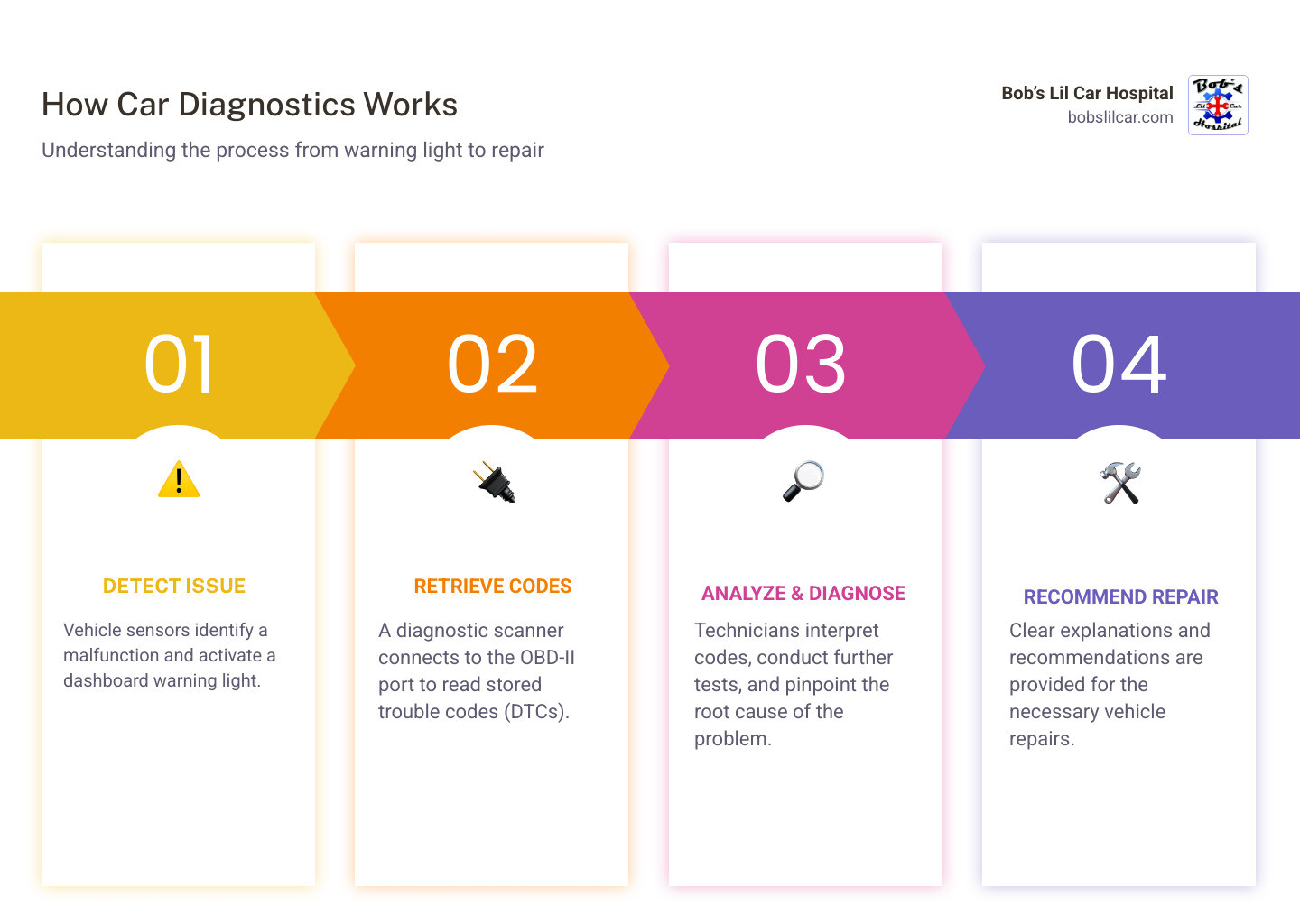
- How it works: A technician connects a scanner to your car’s OBD-II port (usually under the dashboard) to retrieve trouble codes
- What it costs: Basic scans start around $40; more comprehensive diagnostics can cost several hundred dollars depending on complexity
- Time required: A simple code scan takes just a few minutes, though full diagnosis and interpretation may take longer
If you’re like most people, the last thing you want to see is that little amber “Check Engine Light” glaring at you from your dashboard. Your mind races: Is it a loose gas cap? Time for an oil change? Something catastrophic with the engine?
That sinking feeling of uncertainty is exactly why car diagnostics exist.
Modern vehicles are essentially computers on wheels, with anywhere from 30 to 50 electronic modules monitoring everything from your fuel system to your brakes. Your car is constantly communicating with you through warning lights and sensors, but understanding that communication requires the right tools and knowledge.
The good news? Car diagnostics have become much more accessible. Whether you’re facing an illuminated warning light, experiencing unusual noises, or simply want to stay ahead of potential problems, understanding how diagnostic tests work empowers you to make informed decisions about your vehicle’s care.
There are literally hundreds of different codes a Check Engine Light can represent. A diagnostic test helps narrow down the issue so you’sre not left guessing—or worse, stranded with your family by the side of the road.
What Are Car Diagnostics and Why Are They Crucial?
At Bob’s Lil Car Hospital, we understand that your car is more than just a mode of transport; it’s an integral part of your daily life. That’s why understanding car diagnostics is so important. A car diagnostic test is a digital analysis of your car’s computer systems and components. It scans for errors or malfunctions before they become dangerous or lead to more extensive, costly repairs. Think of it as a health check-up for your vehicle, leveraging sophisticated computerization to keep your car in optimal working order.
Modern vehicles are incredibly complex, equipped with an intricate network of sensors and onboard computers that continuously monitor various systems. When one of these sensors detects a reading outside its normal operating range, it triggers a Diagnostic Trouble Code (DTC) and often illuminates a warning light on your dashboard – most famously, the “Check Engine” light.
This isn’t just about fixing a problem once it arises. It’s about proactive care and monitoring your vehicle’s health. Ignoring a warning light or a subtle change in performance can turn a minor issue into a major headache, both for your car and your wallet. By understanding what car diagnostics are and why they are crucial, you can prevent small issues from escalating, ensuring your vehicle remains safe, efficient, and reliable for years to come. For more on keeping your vehicle in top shape, check out our insights on Car Maintenance.
How a Car Diagnostic Test Works
The magic of a car diagnostic test begins with your vehicle’s On-Board Diagnostics (OBD) system. Since 1996, all vehicles sold in the United States have been equipped with the universal OBD-II system. This system includes a standardized 16-pin trapezoidal connector, known as the OBD-II port, usually located under the driver’s side dashboard.
When you bring your vehicle to us for a diagnostic test, our certified technicians connect a specialized diagnostic scanner to this port. This scanner acts as a translator, allowing us to communicate with your car’s Electronic Control Unit (ECU) – essentially, your car’s brain. The scanner retrieves any stored Diagnostic Trouble Codes (DTCs), which are five-character alphanumeric codes that pinpoint specific issues or areas of concern within your vehicle’s systems.
Beyond just reading codes, our advanced diagnostic equipment can also access real-time sensor data. This “live data” provides a snapshot of your car’s performance at that very moment, showing readings from various components like oxygen sensors, fuel pressure, engine RPM, and more. This combination of stored codes and live data allows our experts to accurately identify the root cause of a problem, rather than just guessing based on a dashboard light.
The Importance of Regular Car Diagnostics
We often hear from customers in Kelso, Longview, Kalama, Castle Rock, Toutle, and across Southwest Washington who wished they had addressed a minor issue before it became a significant problem. This is precisely why regular car diagnostics are so important.
- Early Problem Detection: Diagnostic tests can detect errors and potential malfunctions long before they become noticeable performance issues or catastrophic failures. Catching problems like a faulty oxygen sensor or a weak ignition coil early can save you from a breakdown.
- Preventing Costly Repairs: Addressing issues early on can prevent them from escalating into more expensive repairs. For example, a minor transmission fluid leak detected during a diagnostic might cost a few hundred dollars to fix, but if left unchecked, it could lead to a complete transmission overhaul costing thousands. We often see how a simple check can prevent a major repair, saving our customers money and stress.
- Ensuring Vehicle Safety: Many vehicle systems, such as brakes, airbags, and stability control, are monitored by the onboard computer. Diagnostic tests can identify potential safety risks that might not be immediately apparent to the driver, protecting you and your loved ones on the road.
- Improving Fuel Efficiency: Issues with your engine, fuel system, or emissions components can significantly impact your car’s fuel economy. A diagnostic test can pinpoint these inefficiencies, allowing for repairs that restore your vehicle’s optimal performance and save you money at the gas pump.
- Extending Vehicle Lifespan: By keeping all systems in proper working order and addressing issues promptly, regular diagnostics contribute significantly to your car’s overall longevity. It’s about maintaining the health of your vehicle, much like regular check-ups help maintain your own health.
- Peace of Mind: Knowing your vehicle’s health status and proactively addressing potential problems provides invaluable peace of mind. You can drive confidently, knowing that your car has been thoroughly checked by professionals who genuinely care.
For more tips on keeping your vehicle robust and reliable, check out our guide on Keeping Your Car Running Strong.
Understanding the Diagnostic Process
When you bring your vehicle to Bob’s Lil Car Hospital for car diagnostics, you’re entrusting us with a thorough examination of its most critical systems. Our goal is to assess the current state of your car, identifying both apparent and underlying issues. We use professional scanning equipment that examines every inch of your vehicle, from the engine to the brakes to the transmission and exhaust system. Tests can also reveal performance issues with fuel, AC, the ignition, and more. Modern cars are equipped with complex computer systems that monitor various components, and our diagnostic tools are designed to read the trouble codes stored in these systems, helping our technicians pinpoint the exact problem area.
Decoding the Language: OBD1 vs. OBD2 and Trouble Codes
The evolution of automotive diagnostics is a fascinating journey. Early vehicles had very limited diagnostic capabilities, often relying on mechanics to simply “listen” to the engine or visually inspect components.
- OBD1 (On-Board Diagnostics – First Generation): Introduced in the early 1980s, OBD1 systems were vehicle- or manufacturer-specific. This meant that each carmaker had its own proprietary diagnostic connector and codes, requiring specialized equipment for each brand. They provided limited data, primarily indicating a malfunction rather than its specific nature. This made diagnosis a bit like solving a mystery with very few clues.
- OBD2 (On-Board Diagnostics – Second Generation): The game changed dramatically with OBD2, which became mandatory for all cars manufactured and sold in the United States starting with the 1996 model year. OBD2 introduced a universal standard, including the common 16-pin connector we mentioned earlier, and a standardized list of Diagnostic Trouble Codes (DTCs). This standardization allows affordable consumer scan tools to read basic codes and provides mechanics with a consistent framework for diagnosis across different vehicle makes and models. The European equivalent became mandatory in 2001.
The heart of OBD2 diagnostics lies in its DTCs. These five-character codes are structured to give specific information:
- First Character (Letter): Indicates the system where the fault occurred.
- P (Powertrain): Engine, transmission, and associated accessories.
- C (Chassis): Steering, suspension, brakes, and other chassis components.
- B (Body): Airbags, power steering, central locking, power windows, etc.
- U (Network/Communication): Issues with communication between vehicle modules.
- Second Character (Number): Indicates if the code is generic (0) or manufacturer-specific (1). Generic codes are standard across all OBD2 vehicles, while manufacturer-specific codes point to issues unique to a particular brand.
- Third Character (Number): Narrows down the location or type of fault within the system. For powertrain codes, for example:
- 1: Fuel/Air Metering
- 2: Fuel/Air Metering (Injector Circuit)
- 3: Ignition System or Misfire
- 4: Auxiliary Emission Controls
- 5: Vehicle Speed, Idle Control, or Auxiliary Inputs
- 6: Computer Output Circuit
- 7, 8, 9, 0: Transmission
- Fourth and Fifth Characters (Numbers): Pinpoint the exact problem.
For example, a P0301 code indicates a powertrain issue (P), is generic (0), relates to the ignition system/misfire (3), and specifically points to a misfire in cylinder #1 (01). While a bare-bones code reader can show you this, interpreting trouble codes accurately often requires more context and professional expertise. You can learn more about Interpreting trouble codes on specialized websites.
Here’s a quick comparison:
| Feature | OBD1 (Pre-1996) | OBD2 (1996-Present) |
|---|---|---|
| Standardization | Manufacturer-specific, no universal standard | Universal standard (SAE J1962) |
| Connector | Varied by manufacturer | Standardized 16-pin connector |
| Data Provided | Limited, primarily fault indication | Comprehensive, real-time data, freeze frame data, I/M readiness |
| Code Structure | Varied by manufacturer | Standardized 5-character DTCs (P, C, B, U) |
| Cost of Tools | Often required proprietary tools, expensive | Affordable consumer scanners available |
| Emissions Focus | Less emphasis on emissions monitoring | Extensive monitoring of emissions systems |
What to Expect During a Professional Test
When you choose Bob’s Lil Car Hospital for a professional car diagnostics test in Southwest Washington, you can expect a comprehensive and transparent process.
First, our skilled technicians will listen carefully to your concerns and any symptoms you’ve noticed, such as strange noises, decreased fuel efficiency, or a flashing check engine light. We’ll then connect our state-of-the-art diagnostic equipment to your vehicle’s OBD-II port.
While a basic code reader might just give you a five-digit number and letter combination, our professional tools go much further. They provide a deeper dive into your car’s systems, allowing us to:
- Retrieve and Analyze DTCs: We don’t just read the codes; we interpret them. A code is only a starting point for diagnosis. For instance, a “Check Engine” light can be triggered by a loose fuel cap, which is a simple fix, but it can also indicate a much more serious underlying issue.
- Review Live Data: We monitor various sensor readings in real-time to observe how different components are performing under actual operating conditions.
- Examine Freeze Frame Data: This data captures specific parameters (like engine speed, temperature, and fuel trim) at the exact moment a DTC was set, providing crucial context for diagnosis.
- Conduct System-Specific Tests: Our advanced scanners can perform tests on individual systems like the fuel system, ignition, and emissions to verify component functionality.
The average time for a basic car diagnostic test with a simple scanner often takes only a few minutes to complete. However, this is just the beginning of the diagnostic process. For us to accurately pinpoint the root cause of a problem, especially for complex or intermittent issues, the diagnostic process can take longer. It involves not just reading codes but analyzing data, performing visual inspections, and often conducting further tests based on the initial findings.
Regarding cost, basic diagnostic tests that don’t turn up any significant issues typically start at about $40. However, more in-depth analyses, particularly when dealing with complex electrical or intermittent problems, and their associated repairs could cost up to several hundred dollars, depending on the issue’s severity and complexity. We always provide a detailed estimate outlining labor and material costs before commencing any work, ensuring honesty and transparency.
DIY vs. Professional Car Diagnostics: Making the Right Choice
With the accessibility of OBD2 scanners, many car owners in Kelso, Longview, and surrounding areas wonder if they can handle car diagnostics themselves. It’s a valid question, and the answer often lies in understanding the benefits and limitations of both DIY and professional approaches.
The DIY Route: Using an OBD2 Scanner
For the curious car owner, a personal OBD2 scanner can be a fantastic tool.
- Types of Scanners:
- Basic Code Readers: These are entry-level devices that simply read and display DTCs. A bare-bones code reader can be had for under $50, and it’s likely to meet the average consumer’s needs for a quick check.
- App-Based Wireless Scanners (Bluetooth/Wi-Fi): These connect to your car’s OBD-II port and transmit data to your smartphone or tablet via an app. They often offer more advanced features than basic readers, including live data, custom dashboards, and even some manufacturer-specific codes, with many available for under $100.
- Advanced Handheld Scanners: These offer more features, better screens, and sometimes more in-depth data analysis, ranging from $100 to several hundred dollars.
- Professional-Grade Scanners: These are used by mechanics and dealerships, offering extensive capabilities like bi-directional controls, module programming, and highly detailed manufacturer-specific data, costing thousands.
- How to Connect and Read Codes:
- Acquire a Scanner: Choose one that fits your needs and budget.
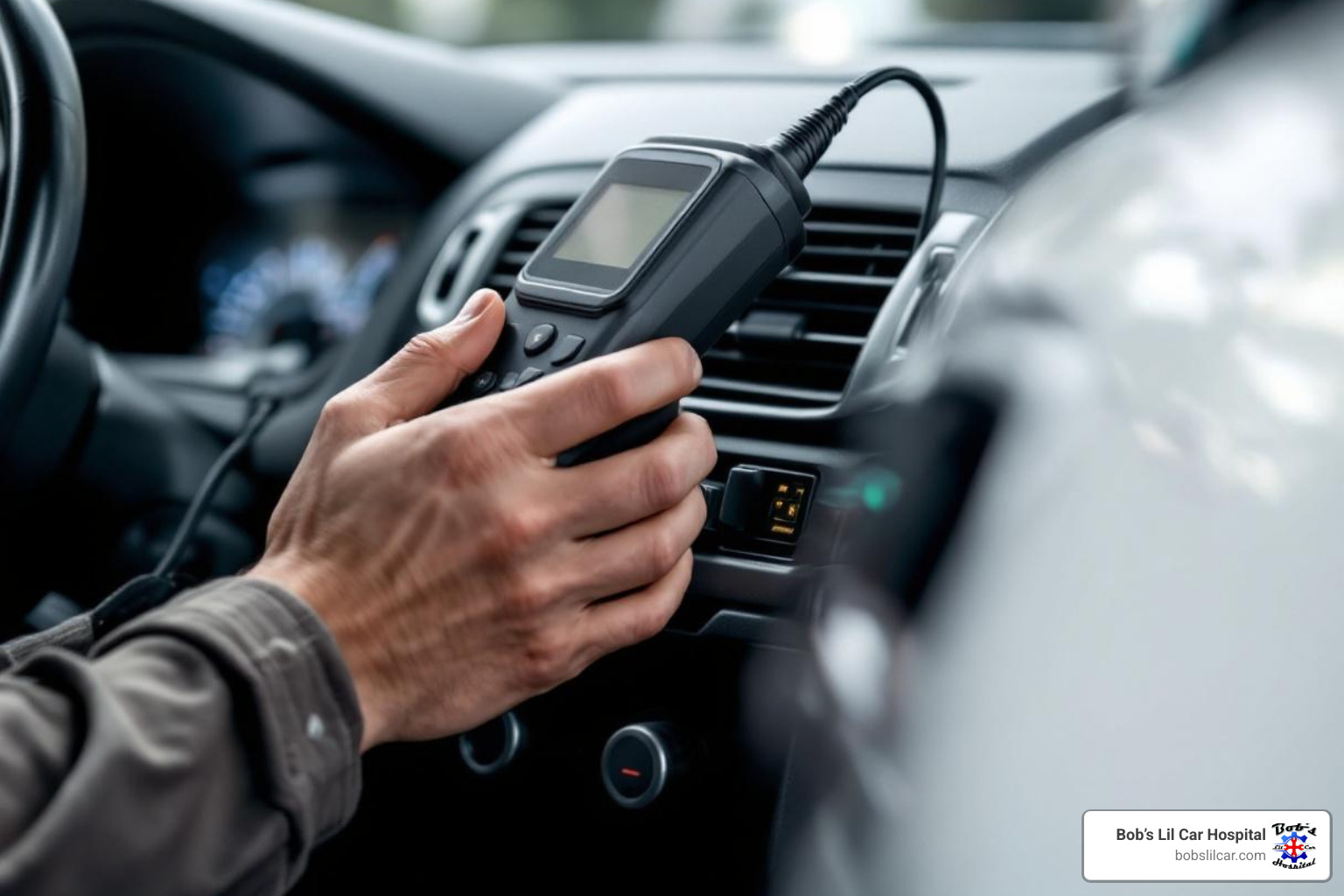
- Locate the OBD-II Port: Typically under the driver’s side dashboard.
- Turn Off Vehicle: Ensure the ignition is off before connecting.
- Insert Scanner: Plug the 16-pin connector firmly into the port.
- Power On: Turn the ignition key to the ‘on’ position without starting the engine.
- Read Codes: Follow the scanner’s instructions to steer to the ‘Read Codes’ or ‘Trouble Codes’ menu.
- Decipher Codes: Write down the codes and use an online resource like How to Use an OBD2 Scanner or OBD-Code’s website to understand their meaning.
- Clearing Codes After Repair: Many scanners allow you to clear codes. However, we advise clearing codes only after a repair has been made to confirm the fix. Clearing codes without addressing the underlying issue will only cause the warning light to return.
- Limitations of DIY Tools: While a DIY scanner can give you a head start, it has limitations. A code often indicates the system with the issue, not the exact faulty part. For example, a code might point to an oxygen sensor, but the actual problem could be a wiring issue. It could also be an exhaust leak or a problem with the ECU itself. Also, only professional-grade or dealership scan tools can diagnose codes outside of powertrain codes (B, C, U) with full accuracy. For more on auto repair topics, visit our Blog.
When to Trust a Professional Mechanic
While DIY scanning can be empowering, there are crucial times when professional expertise is simply indispensable. We pride ourselves on offering that expertise to our community in Southwest Washington.
- Complex Error Codes: Some codes require specialized knowledge to interpret, especially manufacturer-specific ones. A code is only a starting point; a skilled technician uses it to guide further investigation.
- Intermittent Problems: When a warning light comes and goes, or a symptom is inconsistent, diagnosing the root cause requires advanced tools and diagnostic procedures that go beyond a simple code read.
- When a Code is Misleading: It’s common for one problem to trigger a cascade of codes. An experienced mechanic knows how to identify the primary fault and distinguish it from secondary codes. As one source noted, a code does not always indicate a specific faulty part; it points to the affected system. Parts are often replaced unnecessarily if the code is misinterpreted as a direct part failure.
- Need for Advanced Tools: Our shop is equipped with state-of-the-art diagnostic equipment that can perform deeper dives into your vehicle’s systems, conduct bi-directional tests, and access proprietary manufacturer data that basic DIY scanners cannot.
- Verifying the Root Cause: We don’t just clear codes. We diagnose the actual problem, recommend the correct repair, and verify that the repair has fixed the issue. This ensures accurate and lasting solutions.
- Ensuring Accurate Auto Repair: Performing repairs based solely on a DIY code read can lead to incorrect part replacement, further damage, or even voiding your warranty on certain systems. Our ASE-certified technicians have the training and experience to perform repairs correctly the first time.
Using an OBD2 scanner yourself can help you be an informed car owner and communicate better with your mechanic. You can even come to us with the codes you’ve found. We can use that information to guide our professional diagnosis, ensuring you’re making informed repair decisions.
Frequently Asked Questions about Car Diagnostics
We often get asked similar questions about car diagnostics. Our customers across Kelso, Longview, Kalama, Castle Rock, Toutle, and the wider Southwest Washington region. Here are some of the most common ones:
How much does a car diagnostic test cost?
The cost of a car diagnostic test can vary. It depends on the depth of the analysis and the complexity of the issue.
- Basic Scan: If you’re just looking for a simple code read that doesn’t turn up any significant issues, these tests typically start under $100. Many shops offer this as a quick service to retrieve codes when a check engine light illuminates.
- In-Depth Analysis: For more complex issues, intermittent problems, or when no codes are present, but symptoms persist, a more thorough diagnostic process is needed. This involves deeper investigation, live data analysis, and system-specific testing. These more in-depth analyses and their associated repairs could cost up to several hundred dollars. Of course, this depends on the issue’s severity and complexity. Factors influencing the price include the shop’s labor rates, the specific diagnostic equipment, and the time needed for a technician to accurately pinpoint the root cause. We believe in transparency and will always provide a detailed estimate for any diagnostic work before proceeding.
Can a diagnostic test tell me exactly what part to replace?
This is a common misconception! A diagnostic test, especially one using an OBD2 scanner, provides Diagnostic Trouble Codes (DTCs). These codes indicate a problem area or a system that is malfunctioning. It does not typically tell you the exact part that needs to be replaced.
If your car throws a code for a “misfire in cylinder 1” (P0301), it tells us there’s an issue with that specific cylinder’s combustion process. However, the root cause could be a faulty spark plug, a bad ignition coil, a clogged fuel injector, low compression, or even a wiring issue. The code points us to the symptom; our professional diagnostic process helps us find the disease.
Relying solely on a code to replace a part can lead to unnecessary expenses and the original problem persisting. This is where professional expertise becomes invaluable. Our technicians use the DTCs as a guide. We combine them with their experience, further testing, and visual inspections to accurately identify the failed component and ensure an effective repair.
How often should I get a car diagnostic test?
The frequency of car diagnostics depends on several factors:
- When a Warning Light is On: This is the most obvious sign. If your “Check Engine” light illuminates, it’s a clear signal that a diagnostic test is needed. A flashing “Check Engine” light indicates a very serious concern. You should find a safe place to stop and have your car diagnosed immediately.
- Annually for Preventive Care: Many drivers wait until a malfunction occurs. However, we recommend considering an annual diagnostic check, even if no warning lights are on. This proactive approach can catch minor issues before they become major problems. Similar to an annual physical for your own health. If you’re performing DIY tests, a good rule of thumb is to do them once every season (quarterly).
- Experiencing Performance Changes: If you notice any unusual symptoms like decreased fuel efficiency, strange noises, rough idling, hesitation, or any noticeable change in how your car drives, a diagnostic test can help identify the underlying cause.
- Before Purchasing a Used Car: A pre-purchase diagnostic inspection can reveal hidden issues in a used vehicle, helping you make an informed decision and potentially save you from buying a “lemon.”
Conclusion: Take Control of Your Vehicle’s Health
Understanding car diagnostics is no longer just for mechanics. Diagnostics is a vital part of being a responsible and empowered car owner. From decoding that “Check Engine” light to comprehending the difference between OBD1 and OBD2. You now have the knowledge to approach your vehicle’s health with confidence.
We’ve seen how regular diagnostic tests offer numerous benefits. They detect problems early, prevent costly repairs, improve safety, improve fuel efficiency, and ultimately extend your vehicle’s lifespan. You choose to perform a basic DIY scan or rely on our expertise. Being proactive about your car’s care is always the best approach.
At Bob’s Lil Car Hospital, we serve Kelso, Longview, Kalama, Castle Rock, Toutle, and all of Southwest Washington. We are committed to providing exceptional customer service, genuine care, and professionalism. We believe that turning stressful car issues into pleasant experiences starts with clear communication and accurate diagnosis. Our team is here to explain complex vehicle problems, offering precise diagnostics and honest estimates.
Don’t let a warning light or an unfamiliar noise cause you undue stress. Take control of your vehicle’s health today. For a stress-free and accurate diagnosis of your vehicle’s issues, call us to schedule an appointment today. We’re ready to help you get back on the road safely and swiftly.