


Why Auto Electrical Diagnostics Are More Important Than You Think
Auto electrical diagnostics is the process of systematically identifying faults in your vehicle’s electrical system — from the battery and alternator to sensors, fuses, and computer modules.
Here is a quick overview of what it involves:
| Step | What Happens |
|---|---|
| 1. Symptom check | Identify warning lights, flickering lights, slow cranking |
| 2. Visual inspection | Look for corrosion, damaged wires, loose connections |
| 3. Battery & charging test | Measure voltage; healthy battery reads ~12.6V |
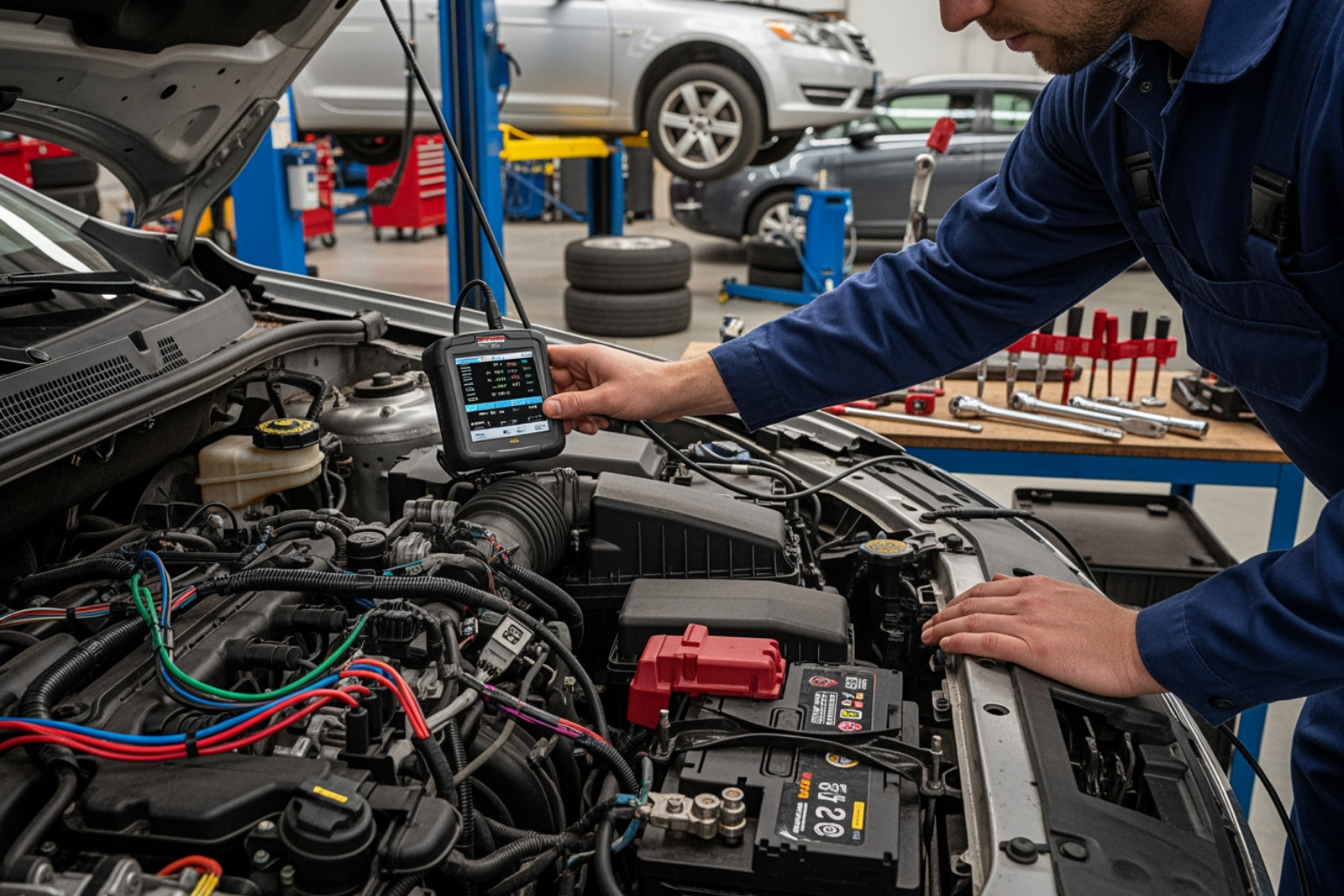
| 4. Scan tool check | Retrieve diagnostic trouble codes (DTCs) from the ECU |
| 5. Circuit testing | Use a multimeter to test voltage, continuity, and grounds |
| 6. Targeted repair | Fix or replace only what is actually faulty |
Modern vehicles are no longer just mechanical machines. Every time you start your car, dozens of electronic systems wake up simultaneously — from the engine control unit to your safety features. When something goes wrong electrically, the effects ripple fast.
A single poorly connected wire can trigger multiple warning lights, kill your battery overnight, or leave you stranded on the side of the road with a car full of kids.
That’s not an exaggeration. Electrical faults are among the most misdiagnosed problems in auto repair — and the most stressful for everyday drivers who just need their car to work.
The good news? Most electrical problems follow clear, traceable patterns. With the right approach, they are very solvable.
I’m William Dickinson, and I bring over 20 years of experience translating complex topics — including auto electrical diagnostics — into clear, actionable guidance for everyday drivers. In this guide, we’ll walk you through everything you need to know, step by step.
Auto electrical diagnostics word guide:
Common Symptoms Requiring auto electrical diagnostics
When your car starts acting up, it often feels like it’s speaking a different language. Those car electrical issues rarely stay quiet for long. Recognizing the early warning signs can save you from a major headache later.
Flickering headlights are a classic red flag. If your lights dim when you idle or brighten when you rev the engine, your system is struggling to maintain a steady flow. You might also notice your power windows moving slower than usual.
Slow engine cranking is another major symptom. If the engine groans or takes several tries to turn over, your starter isn’t getting enough “juice.” Sometimes, you’ll hear a rapid clicking sound when you turn the key. This usually means the starter solenoid is trying to engage, but the voltage is too low to finish the job.
Never ignore burning smells. A sharp, “electrical” odor—similar to burnt plastic—indicates that a wire or component is overheating. This is a safety priority that needs immediate auto electrical diagnostics. Similarly, if you find yourself replacing the same blown fuse repeatedly, don’t just put a bigger fuse in. That fuse is a “sacrificial lamb” protecting your car from a fire. A recurring blown fuse is a clear sign of an underlying short circuit.

Identifying Battery and Charging System Failures
The battery is the heart of your car’s electrical life. Without a healthy one, accurate electrical diagnostics are nearly impossible. Batteries are incredibly sensitive to the weather in Southwest Washington. What kills batteries most often? Extreme temperatures. Heat evaporates internal fluids, while cold saps cranking power.
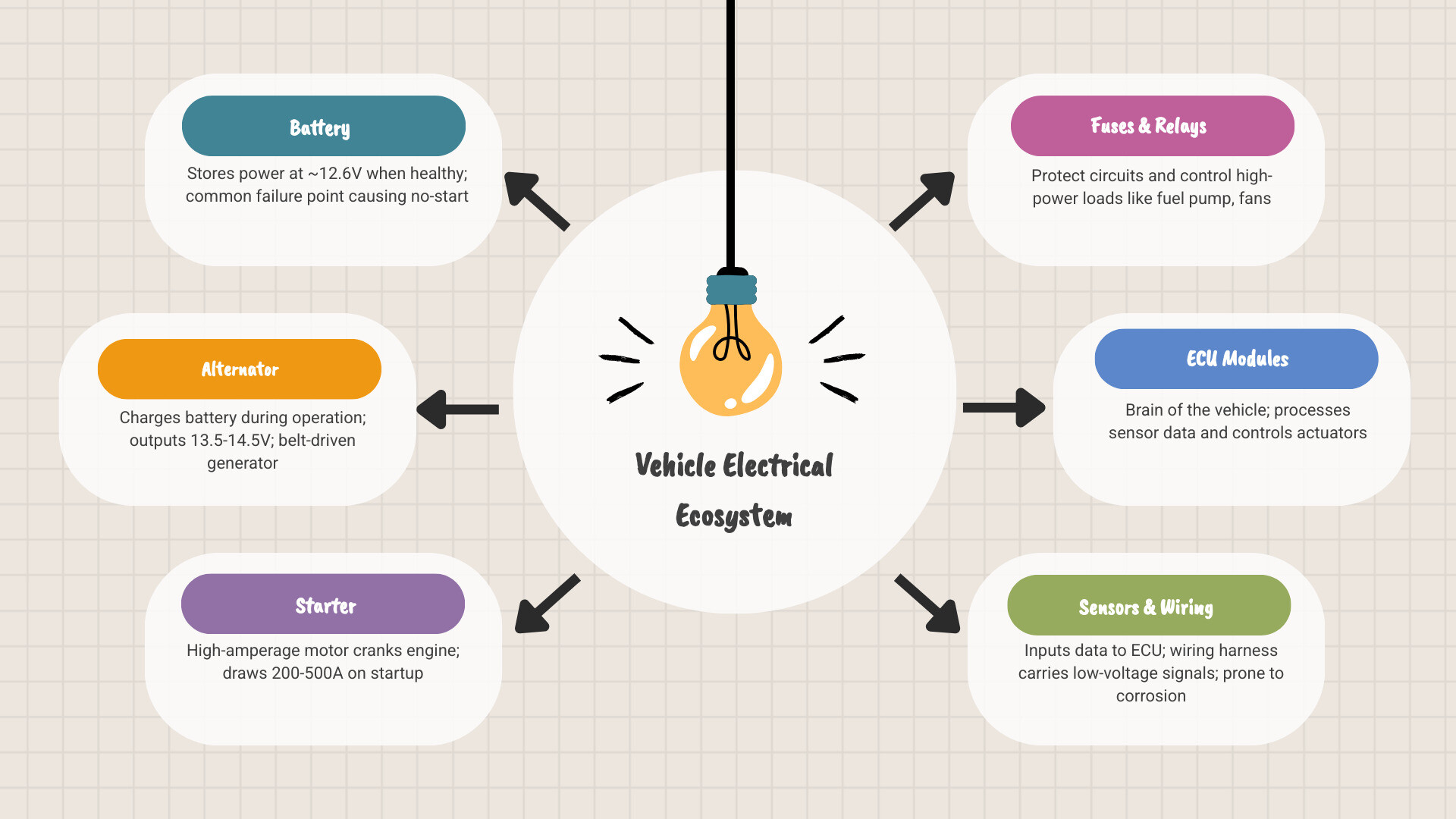
To understand your battery’s health, you need to look at the numbers. A healthy battery should show about 12.6 volts when the engine is off. When the car is running, the alternator takes over. It should push that voltage up to between 13.5 and 14.5 volts. If it stays below 13 or climbs above 15, your charging system is failing.
From test to trusty navigating battery services with ease is all about knowing when a battery can be saved and when it’s time for a replacement.
| Battery State | Voltage Reading (Engine Off) | Status |
|---|---|---|
| Fully Charged | 12.6V – 12.8V | Healthy |
| 75% Charged | 12.4V | Needs Charge |
| 50% Charged | 12.2V | Weak |
| Discharged | 12.0V or lower | Dead / Failing |
Essential Tools for Modern auto electrical diagnostics
You don’t need a spaceship to fix a car, but you do need the right gear. The “big three” of electrical work are a digital multimeter, a test light, and a wiring diagram.
The digital multimeter is your most versatile friend. It measures voltage, resistance, and continuity. Think of it as a stethoscope for your car’s wiring. A basic test light is also helpful for quickly checking if a circuit has power. If the light glows, you have “hot” voltage at that point.
For more efficient testing, tools like the Power Probe allow technicians to apply power or ground directly to a component. This helps us see if a motor or light works without having to take the whole dashboard apart. However, even the best tools are useless without a map. Intricate wiring networks in modern cars require vehicle-specific diagrams to navigate safely.
Advanced Tools for auto electrical diagnostics
As cars become more like rolling computers, we have to use computer-based tools. Most modern vehicles have multiple computers (ECUs) that talk to each other. When a fault occurs, these computers store Diagnostic Trouble Codes (DTCs).
We use high-end OBD-II scanners to read these codes. But a code doesn’t always mean a part is bad. For example, a “Lean Oxygen Sensor” code might actually be caused by a broken wire, not a faulty sensor.
For the most stubborn “ghosts in the machine,” we use a PicoScope. This is an oscilloscope that allows us to see electrical signals in real-time. It creates a “waveform” on a screen. If a sensor has a tiny glitch that happens in a millisecond, the scope will catch it when a standard multimeter would miss it.
A Systematic Approach to Electrical Troubleshooting
At Bob’s Lil Car Hospital, we don’t guess—we test. A systematic approach is the only way to avoid “throwing parts” at a problem.
The first step is always a thorough visual inspection. You would be surprised how many issues are caused by a loose battery terminal or a wire that a squirrel decided looked like a snack. We look for green or white crusty buildup on terminals—that’s corrosion, and it’s the number one enemy of electricity. Corrosion creates resistance, and resistance stops power from flowing.
The definitive guide to diagnosing car problems always emphasizes checking your grounds. In a car, the metal frame acts as the return path for electricity. If the ground wire is loose or rusty, the electricity can’t get back to the battery, and the circuit fails.
Mastering Voltage Drop and Continuity Testing
When a light is dim but not out, we often perform a voltage drop test. This is based on Ohm’s Law. We measure the voltage “lost” as it travels across a connection or a switch. Ideally, you want to see less than 0.1 volts of drop. If we see 0.5 volts or more, we’ve found a bad connection. Mastering voltage drop is the difference between a “parts changer” and a real technician.
We also test for:
- Continuity: Ensuring the path is unbroken from start to finish.
- Short to Ground: Finding where a “hot” wire is touching the frame and blowing fuses.
- Open Circuits: Finding where a wire is broken internally.
Solving Complex Issues: Parasitic Drains and Intermittents
Is your car dead every morning? You likely have a parasitic drain. This happens when a computer or light stays “awake” after you turn the car off.
Modern cars are tricky because they don’t go to sleep immediately. It can take 15 to 45 minutes for all the modules to enter “sleep mode.” We test this by connecting a multimeter in series with the battery and watching the milliamp draw. A normal draw is between 25 and 50 milliamps. If it’s over 100, something is stealing your power. We then pull fuses one by one until the draw drops, which tells us exactly which circuit is the thief.
Intermittent problems are the most frustrating. These are the issues that disappear as soon as you pull into the repair shop. These “gremlins” are often triggered by heat or vibration. We use “wiggle tests”—literally shaking the wiring harness while the car is running—to see if we can trigger the fault. Applying principle to reality means being patient and recreating the exact conditions where the failure occurs.
Frequently Asked Questions about Electrical Systems
What are the signs of a bad ground connection?
Bad grounds cause the weirdest problems. You might notice your turn signals flashing rapidly, or your dash lights dimming when you hit the brakes. Sometimes, one circuit will “back-feed” into another. For example, your radio might cut out only when you turn on your headlights. If your car has “gremlins” that don’t seem to make sense, check the grounds. Even the best batteries can’t overcome a poor ground connection.
How do I test for a parasitic battery drain?
You’ll need a multimeter set to DC Amps. Disconnect the negative battery cable and place the meter between the cable and the battery post. Warning: Do not start the car or turn on high-draw items like the heater, or you will blow the fuse in your meter! Wait for the car to go to sleep. If the reading stays high, you have a dead battery waiting to happen.
When to Seek Professional auto electrical diagnostics?
If your car has a complex ECU fault, needs ADAS (Advanced Driver Assistance Systems) recalibration, or involves a hybrid’s high-voltage system, it’s time to call the pros. High-voltage systems in hybrids can be lethal if handled incorrectly. If you are searching for car electrical diagnostic near me, look for a shop that has the right diagnostic subscriptions and safety training.
Conclusion
Electrical systems are the nervous system of your vehicle. While they can be complex, they aren’t magic. Most issues come down to simple things: a weak battery, a bit of corrosion, or a loose ground. Preventative maintenance—like keeping your battery terminals clean and checking your alternator belt—can keep you on the road and out of the shop.
At Bob’s Lil Car Hospital, we pride ourselves on solving the problems other shops shy away from. Whether you’re in Kelso, Longview, or Woodland, we treat your car with the genuine care and professionalism it deserves. We turn those stressful “check engine” moments into pleasant, easy-to-understand experiences.
Want to learn more info about our services? We are here to help.
Do you have a strange electrical glitch that’s driving you crazy? Call us today at Bob’s Lil Car Hospital to ask a question about your vehicle’s electrical health!