
Why Electrical Problems Leave You Stranded
An electrical problem car can leave you stuck in a parking lot, late for work, or stranded with your family. When you turn the key and hear only silence—or worse, a clicking sound—you’re likely facing one of the most common automotive issues: electrical failure.
Quick answer: Most electrical problems stem from three culprits:
- Dead or weak battery – Won’t hold a charge or has corroded terminals
- Failing alternator – Not recharging the battery while driving (look for dimming lights)
- Bad starter motor – Produces clicking or grinding sounds when you turn the key
Other common signs include:
- Dashboard warning lights (especially battery or check engine)
- Blown fuses that keep failing
- Burning plastic smell
- Power windows or locks not working
- Headlights flickering or dimming at idle
According to industry data, battery problems account for roughly 40% of all electrical-related service visits. The good news? Many electrical issues are diagnosable at home with simple tools, and knowing what to look for can save you time and stress.
I’m William Dickinson, and through decades of working with automotive businesses, I’ve helped countless drivers understand and resolve electrical problem car situations before they escalate into major repairs. This guide will walk you through the troubleshooting process step-by-step, so you can identify whether you’re dealing with a simple fix or something that requires professional attention.
Understanding Your Vehicle’s Power Trio
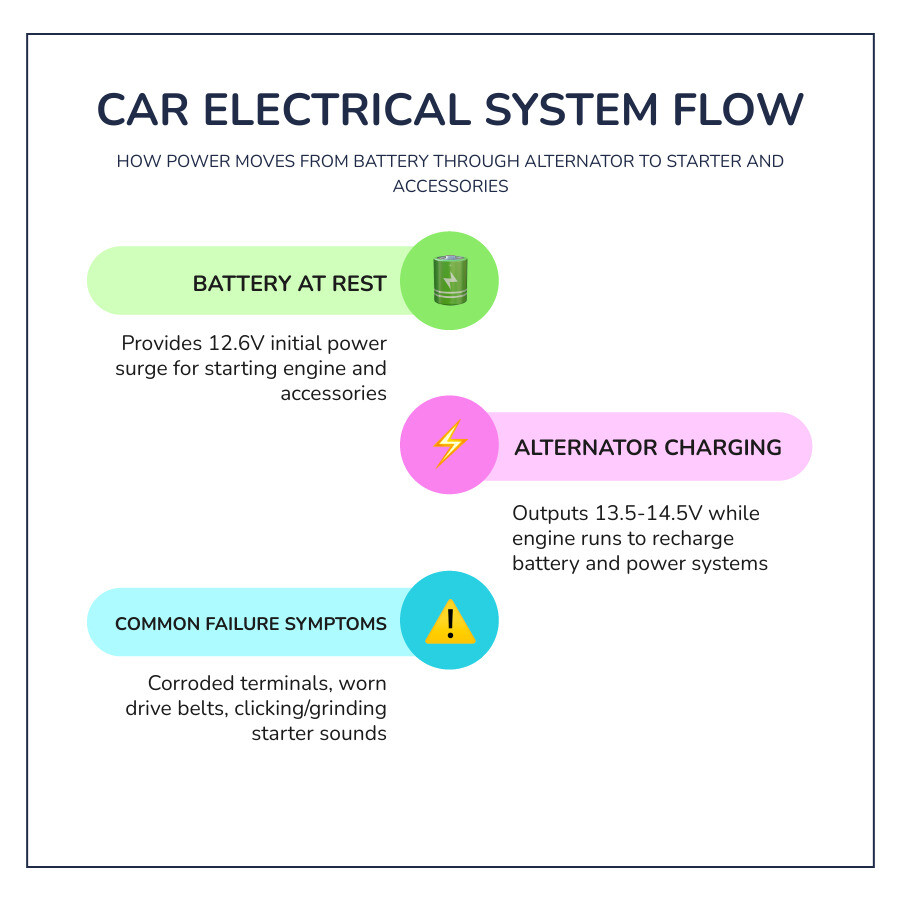
To solve an electrical problem car, we first need to understand how the system creates and uses power. Think of your car’s electrical system as a team of three main athletes: the battery, the alternator, and the starter. If one member of this trio slacks off, the whole car suffers.
The battery is the heart of the system. It provides the initial surge of power to get things moving. However, it cannot run the car forever on its own. Once the engine is running, this component recharges the battery and powers the electrical components while you drive. If you find yourself frequently dealing with a Dead Battery, it might be because the charging cycle is broken.
The starter motor is the heavy lifter. It takes electricity from the battery and uses it to physically turn the engine over. This requires a massive amount of current—anywhere from 200 to 400 amps for a few seconds. If there is a bottleneck in the wiring or the battery is weak, the starter simply won’t have the muscle to do its job.
The Roles of the Battery and Alternator
The battery stores chemical energy and converts it into electrical current. Most car batteries last four to six years. However, in our region—from Longview, WA down to Rainier, OR—temperature swings can shorten that lifespan. We often see batteries failing around the three-year mark if they aren’t maintained.
The alternator is a belt-driven generator. As the engine turns, it spins a rotor inside a stator. This creates alternating current (AC), which is then converted to direct current (DC) to power your headlights, radio, and heater. It also acts as a voltage regulator. It ensures your car’s electronics receive a steady flow of power, usually between 13.5 and 14.5 volts. If the alternator fails, your car will run entirely off the battery until it dies, leaving you with a dark dashboard and a stalled engine.
Identifying the Signs of an Electrical Problem Car
Recognizing a failing system early can prevent a total breakdown. We often tell our customers that their car “talks” to them through symptoms. You just have to know how to listen.
One of the most obvious signs is dimming headlights or interior lights. If your lights get brighter when you rev the engine but dim when you idle, your alternator is likely struggling. You might also notice erratic radio behavior or slow power windows. These are classic signs of low voltage.
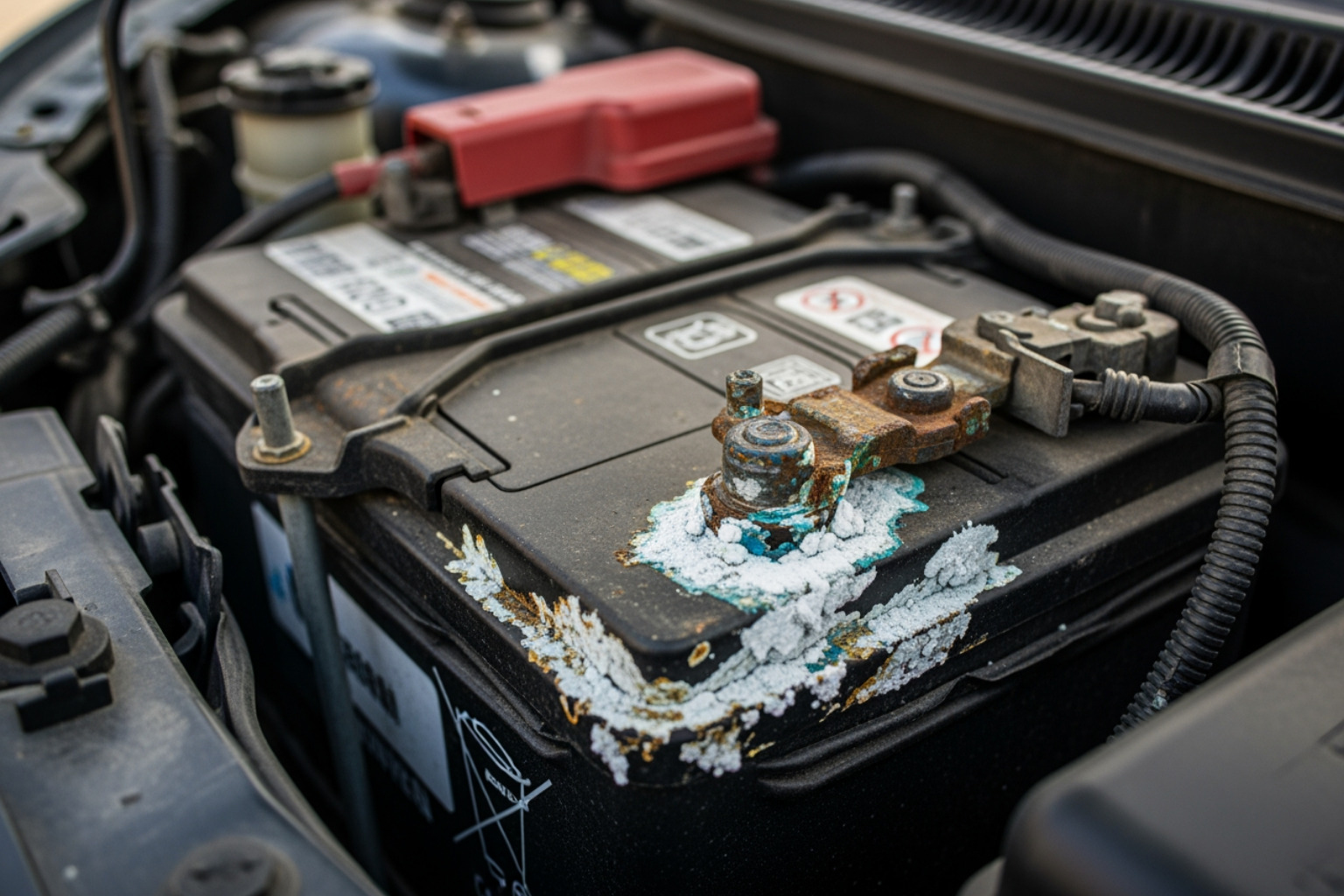
Corrosion is another major red flag. If you pop the hood and see white, ashy, or blue-green crust on the battery terminals, that is a physical barrier to electricity. It prevents the battery from charging and makes it harder for the starter to get power. If you notice these issues, it is time for professional Electrical Diagnostics to see if the damage has spread to the cables.
Distinguishing Between Battery and Starter Failures
When your car won’t start, it can be hard to tell if you need a new battery or a new starter. A rapid clicking sound when you turn the key usually means the battery has enough power to engage the starter solenoid, but not enough to actually spin the motor.
A grinding noise, on the other hand, often indicates a mechanical failure in the starter motor itself or the flywheel. If your interior lights stay bright when you try to start the car, the battery is likely fine, and the starter is the culprit. If the lights go completely dark the moment you turn the key, the battery is almost certainly dead.
Learning How to Jumpstart Your Car is a great first step. If the car starts with a jump and keeps running, the battery was likely just discharged. If it dies shortly after you remove the cables, your alternator isn’t doing its job.
| Symptom | Likely Culprit | Why? |
|---|---|---|
| Rapid Clicking | Battery | Not enough voltage to hold the solenoid. |
| Grinding Noise | Starter | Worn gears or failing motor internals. |
| Dimming Headlights | Alternator | System voltage is dropping under load. |
| No Sound / No Lights | Battery | Complete loss of power or disconnected terminals. |
| Burning Smell | Wiring/Short | Electrical insulation is melting from high heat. |
Step-by-Step DIY Troubleshooting and Diagnosis
You don’t need to be a master mechanic to perform basic Diagnostics on your vehicle. A few simple tools can give you a clear picture of what’s going on under the hood. We recommend starting with a visual inspection. Look for frayed wires, loose connections, or signs of moisture around the fuse box.
Cleaning your terminals is a high-impact, low-effort task. Use a wire brush and a mixture of baking soda and water to neutralize acid and clear away corrosion. Ensure the cables are tight; you shouldn’t be able to wiggle them by hand. A loose ground wire can cause a whole host of intermittent electrical issues that are notoriously hard to track down.
How to Test for an Electrical Problem Car at Home
The best tool for diagnosing an electrical problem car is a digital multimeter. To get an accurate reading, your car should be off for at least an hour. Set your multimeter to DC voltage and touch the probes to the battery terminals.
A healthy battery should show about 12.6V at rest. If it reads 12.2V, it is only about 50% charged. If it is below 12V, it is essentially dead. Once you start the engine, the reading should jump to between 13.5V and 14.5V. If the voltage stays the same or drops after the engine starts, your alternator is failing. You can learn more about this in our guide on Navigating Battery Services with Ease.
If your battery dies overnight but tests fine during the day, you might have a parasitic draw. This happens when a component stays on after the car is turned off. We measure this by putting the multimeter in “Amps” mode and connecting it in series with the negative battery cable. A normal draw is 20-50 milliamps. Anything over 100mA will drain a battery in a matter of days.
Inspecting Fuses and Wiring Integrity
Fuses are the “sacrificial lambs” of your car. They are designed to break the circuit if too much electricity flows through, protecting sensitive computers. Most cars have two fuse boxes: one under the hood and one inside the cabin.
A blown fuse is easy to spot—look for the broken metal link inside the plastic housing. However, if a fuse blows repeatedly, do not just keep replacing it. This signals a short circuit or an overloaded circuit that needs investigation.
Modern cars often feature Intricate Wiring Networks that use soy-based insulation. Unfortunately, rodents love the taste of this insulation. If you live in more rural areas like Toutle or Castle Rock, check for chewed wires or nests under the intake manifold. Rodent damage can cause “ghost” electrical issues that come and go with the weather.
Modern Complexity: Sensors and Parasitic Drains
Today’s vehicles are essentially rolling computers. They rely on Multiple Computers communicating over a CAN bus network. This means a fault in one area, like a bad TPMS sensor or a failing oxygen sensor, can sometimes cause issues in seemingly unrelated systems.
If your dashboard looks like a Christmas tree, don’t panic. Often, multiple warning lights indicate a single voltage problem rather than ten different mechanical failures. When the battery voltage drops, the car’s computers (ECUs) can’t function properly, leading to a cascade of error codes. This is why we always check the battery and ground connections first when dealing with Car Electrical Issues.
When to Seek Professional Help for an Electrical Problem Car
While DIY checks are great, some issues require specialized equipment. If you smell burning plastic or see smoke, stop immediately. Electrical fires are dangerous and can destroy a car in minutes.
You should seek a Car Electrical Diagnostic Near Me if you encounter:
- Intermittent stalling while driving.
- High-voltage issues in hybrid or electric vehicles (never touch orange cables!).
- Problems that require an oscilloscope to track down signal interference.
- Repeatedly blown main fuses or fusible links.
Professional shops use advanced diagnostic tools that can “talk” to every module in the car. This allows us to see exactly which sensor is failing without guessing.
Frequently Asked Questions about Electrical Issues
What causes a parasitic battery drain?
A parasitic drain occurs when an electrical component fails to “go to sleep” after the ignition is turned off. Common culprits include glove box lights that stay on, aftermarket alarms, or faulty infotainment modules. In some cases, a bad alternator diode can actually allow electricity to flow backward out of the battery when the car is parked. If you’re struggling with this, checking our Batteries category can provide more deep-dive tips.
Why do my fuses keep blowing repeatedly?
If a fuse blows as soon as you replace it, you have a “hard short” to ground. This usually means a power wire has rubbed through its insulation and is touching the metal frame of the car. It could also be caused by a failed component, like a seized wiper motor, drawing too much current. Never use a fuse with a higher amperage rating than specified; doing so can cause a fire.
How does cold weather affect my car’s electrical system?
Cold weather is a double whammy for your car. First, the chemical reaction inside the battery slows down, reducing its “cranking amps.” At freezing temperatures, a battery loses about 30% of its strength. Second, the oil in your engine thickens, making it much harder for the starter to turn the engine. This is why you often need a Jumpstart on those chilly Southwest Washington mornings.
Conclusion
At Bob’s Lil Car Hospital, we know that an electrical problem car can be incredibly frustrating. Our goal is to take that stress away with genuine care and professional expertise. Whether you’re in Woodland, Kelso, or Castle Rock, we are here to help you navigate everything from a simple battery swap to complex wiring repairs.
Regular maintenance is the best way to prevent being left in the dark. Keep your terminals clean, test your battery annually after its third birthday, and never ignore a flickering dashboard light. By staying proactive, you can keep your vehicle’s “power trio” in perfect harmony.
If your car is acting up or you’re worried about a strange smell or sound, don’t wait for a breakdown. We pride ourselves on turning stressful car issues into pleasant experiences. Call us today to ask any questions about your vehicle’s electrical health! We would love to help you get back on the road safely.