
Understanding the Cost Behind a Critical Repair
Transmission box repair cost varies significantly based on the type of work needed and your vehicle. Here’s what you need to know right away:
Quick Cost Breakdown:
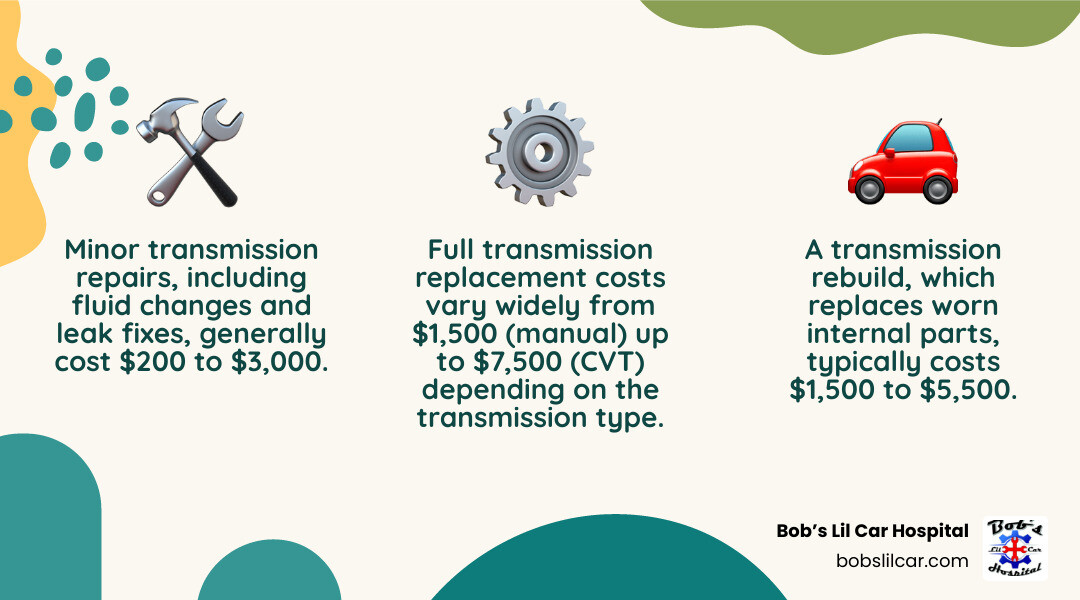
- Minor Repairs (fluid leaks, solenoids): $200 – $3,000
- Transmission Rebuild: $1,500 – $5,500
- Full Replacement (Manual): $1,500 – $4,000
- Full Replacement (Automatic): $2,500 – $6,000+
- CVT Replacement: $4,000 – $7,500
- Labor Costs: $70 – $150 per hour (4-18 hours typical)
That sinking feeling when your car refuses to shift smoothly is something no driver wants to experience. Your transmission is arguably one of the most complicated pieces of gear in your vehicle, second only to the engine itself. It’s the critical link that converts your engine’s power into controlled motion, and when it fails, the fear of a massive repair bill hits immediately.
The reality is this: transmission work is expensive because it’s complex, labor-intensive, and requires specialized expertise. But not every transmission problem means you need a full replacement.
Many factors influence what you’ll actually pay. The type of transmission in your vehicle (manual, automatic, or CVT), whether the damage is minor or severe, and even your vehicle’s make and model all play a role. Some repairs are as simple as replacing a solenoid for a few hundred dollars, while others require pulling the entire transmission and rebuilding it from the inside out.
This guide breaks down the real costs you’re facing, explains the factors that drive those numbers, and helps you understand your options. Whether you’re dealing with slipping gears, strange noises, or fluid leaks, you deserve to know what’s happening under your hood and what it will take to fix it.
Recognizing the Warning Signs: Does Your Transmission Need Help?
When your transmission is starting to struggle, your vehicle often tries to tell you. Ignoring these early warnings can lead to more severe damage and, ultimately, a higher transmission box repair cost. We’ve seen it all too often in our shops across Southwest Washington, from Longview to Kelso. Here are the most common signs that your transmission might be in distress and needs professional attention:
Slipping Gears:
This is one of the most common and alarming signs. You might feel your car hesitate or “slip” out of gear while driving, or the engine RPMs might suddenly increase without a corresponding increase in vehicle speed. It’s like your car is struggling to keep up with what you’re asking it to do.
Delayed or Rough Shifting:
If there’s a noticeable pause or a harsh “clunk” or “thud” when your car shifts gears, whether from park to drive, or between gears while accelerating, it’s a red flag. Smooth transitions are key to a healthy transmission.
Whining, Clunking, or Humming Noises:
Any unusual sounds coming from under your car, especially during shifts or when in neutral, can indicate internal transmission problems. Grinding noises are particularly concerning for manual transmissions.
Burning Smell from Fluid:
If you detect a sweet, acrid, or burning odor, it could be overheated transmission fluid. This often points to low fluid levels or internal friction, which can quickly damage components.
Red or Brown Fluid Leaks Under the Car:
Transmission fluid is usually bright red and has a sweet smell. If you see reddish-brown fluid puddles under your parked car, it’s a clear sign of a leak. Untreated leaks can lead to dangerously low fluid levels and catastrophic failure.
Check Engine Light:
Modern vehicles are equipped with sophisticated sensors. If your check engine light illuminates, it could be triggered by a transmission-related error code. While it doesn’t always mean transmission failure, it certainly warrants a diagnostic scan.

Driving with any of these symptoms is risky and can lead to further, more expensive damage. Some issues, like a bad wheel speed sensor or ignition coil, can even mimic transmission failure, which is why accurate diagnosis is so crucial. Don’t guess; let us help you get to the bottom of it. For more information on our diagnostic services, visit our Auto Repair page.
Decoding the Bill: Factors Influencing Your Transmission Box Repair Cost
Understanding why a transmission box repair cost can vary so widely is key to being an informed vehicle owner. It’s not just one number; it’s a combination of several critical factors. When we provide an estimate at Bob’s Lil Car Hospital, we consider all of these elements to give you the most accurate picture for your specific vehicle in Kelso, Longview, or anywhere in Southwest Washington.
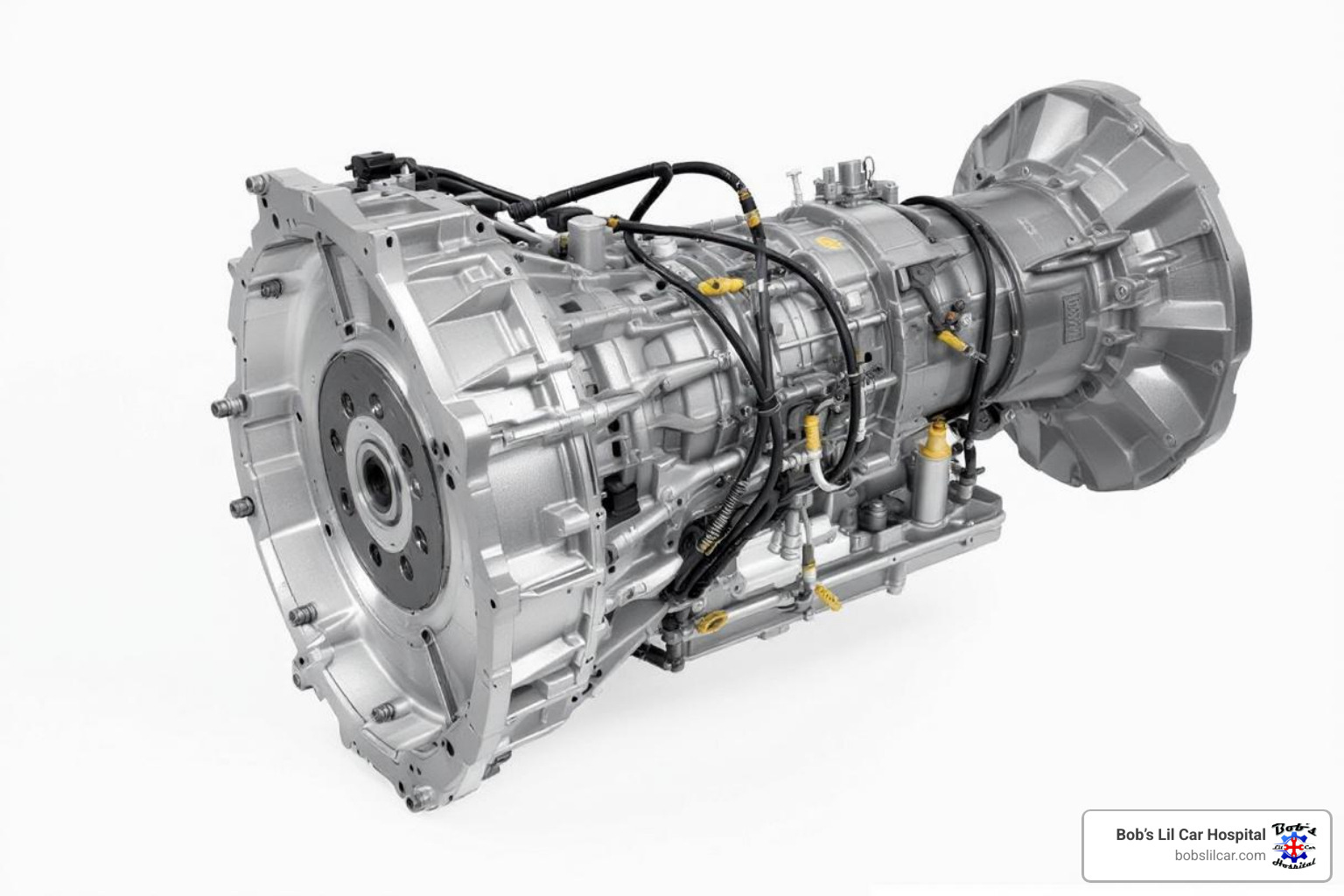
Here are the main factors that influence your final bill:
- Vehicle Make and Model: Luxury vehicles, sports cars, and certain foreign makes often have higher parts costs and require specialized tools or knowledge, driving up the expense. A compact sedan will almost always be less expensive to repair than a high-performance SUV.
- Transmission Type: As we’ll dig into more, manual, automatic, and Continuously Variable Transmissions (CVTs) have different complexities and therefore different repair price tags.
- Severity of Damage: A minor issue, like a faulty sensor, is a quick fix. A completely failed internal component, however, requires extensive labor and parts, leading to a much higher cost.
- Labor Costs: Transmission work is incredibly labor-intensive. Mechanics need specialized skills and often dedicated equipment to remove, disassemble, repair, and reinstall these complex units. Labor costs can range from $70 to $150 per hour, and a full transmission replacement can require 8 to 12 hours of labor, sometimes even up to 18 hours for complex jobs.
- Parts Availability: If your vehicle uses common, readily available parts, the cost will be lower. For older or rarer models, sourcing parts can be challenging and expensive, sometimes requiring custom fabrication or lengthy searches for used components.
Manual vs. Automatic Transmission Repair Costs
One of the first questions we’ll ask is whether your vehicle has a manual or an automatic transmission. This distinction significantly impacts the potential transmission box repair cost.
- Manual Transmission Complexity: Manual transmissions are generally simpler in design compared to automatics. They rely on mechanical gears and a clutch system that you operate directly. Common issues often involve the clutch, which wears out over time and requires replacement. A manual transmission replacement can cost between $1,500 to $4,000 for the part alone. Labor for manual transmissions might add $280 to $900, typically requiring 4-6 hours of work.
- Automatic Transmission Complexity: Automatic transmissions are far more intricate, incorporating hydraulic systems, electronic controls, torque converters, and numerous internal components. Problems can range from torque converter issues to faulty solenoids (small electronic valves that control fluid flow). Automatic transmission replacement can cost anywhere from $2,500 to $6,000 or more for the unit itself. Labor for automatic transmissions is also generally higher, adding $420 to $1,500 or more, often requiring 6-10 hours due to their complexity and integration.
While manual transmissions might seem like a cheaper fix on the surface, extensive internal damage can still lead to substantial bills. However, for many common repairs, manual transmissions often have a lower overall transmission box repair cost.
The Impact of Modern Transmissions on Repair Costs
The automotive world is constantly evolving, and transmissions are no exception. The introduction of new technologies has brought about greater efficiency but often comes with increased repair complexity and cost.
- CVT (Continuously Variable Transmission) Design: CVTs operate differently from traditional automatics, using a belt and pulley system to provide a continuous range of gear ratios. While they offer smooth acceleration and fuel efficiency, their unique design makes them more expensive to repair or replace. A CVT transmission replacement can cost between $4,000 to $7,500. Some automakers even limit the availability of internal parts, making total replacement the only viable option.
- Dual-Clutch Transmission (DCT) Specialization: DCTs combine the efficiency of a manual with the convenience of an automatic. They are found in many performance and luxury vehicles. Their specialized design and intricate electronic controls mean that repairs and replacements are often more costly and require technicians with specific training.
- Increased Complexity of 8, 9, and 10-speed Automatics: Many newer vehicles feature automatics with an increasing number of gears. While these offer improved performance and fuel economy, the added complexity means more components that can potentially fail, and more intricate repair processes. This complexity directly translates to higher labor hours and, consequently, higher transmission box repair cost.
Understanding Your Specific Transmission Box Repair Cost Estimate
When you bring your vehicle to Bob’s Lil Car Hospital, we aim to provide a clear and transparent estimate. Here’s what goes into that:
- Diagnostic Fees: Before any repair, a thorough diagnostic is essential. This often involves checking for trouble codes, inspecting fluid levels and condition, and performing road tests. Sometimes, what seems like a transmission issue is actually a problem with an interconnected electronic system, like a faulty wheel speed sensor or ignition coil. A proper diagnosis ensures you’re not paying for a transmission replacement when a simpler fix is needed.
- Local Labor Rates: Our labor rates are competitive for the Southwest Washington area, typically falling within the $70-$150 per hour range. We believe in fair pricing for expert work.
- Sourcing OEM vs. Aftermarket Parts: We’ll discuss options for parts. Original Equipment Manufacturer (OEM) parts are from your vehicle’s manufacturer and guarantee a perfect fit, but can be more expensive. Aftermarket parts offer a more budget-friendly alternative. We’ll help you weigh the pros and cons for your situation.
The best way to get a precise transmission box repair cost estimate for your vehicle is to bring it in for an inspection. We’re happy to provide a personalized estimate based on our findings. Contact us for a personalized estimate.
Repair, Rebuild, or Replace? Choosing the Most Cost-Effective Solution
When faced with a transmission problem, you essentially have three main paths: repair, rebuild, or replace. Each has its own benefits, drawbacks, and, of course, associated costs. Deciding which route to take depends on the severity of the damage, your budget, and the overall condition of your vehicle. We’ll help you steer this major decision right here in Southwest Washington.
Minor Transmission Repairs: The Quickest Fix
Sometimes, a transmission problem isn’t a death sentence for the entire unit. Many issues can be resolved with smaller, targeted repairs, leading to a much lower transmission box repair cost than a full replacement.
- Solenoid Replacement: Transmission solenoids are electronic components that control the flow of transmission fluid. If one goes bad, it can cause shifting problems. Replacing a solenoid can cost between $75 to $450.
- Fluid Leak Repair: A leak might be caused by a worn gasket or seal. Fixing a transmission fluid leak can cost between $200 to $600, including the gasket, filter, and fresh fluid. This is a far cry from the cost of a full replacement!
- Gasket and Seal Replacement: Over time, these components can dry out and crack, leading to leaks. Replacing them can often resolve fluid loss issues.
- When a Simple Repair is Enough: Minor repairs are usually sufficient if the problem is isolated to an external component, an electrical sensor, or a small leak. If only one major part is broken, a repair can be a very cost-efficient option. Transmission fluid changes, which are preventative, typically cost $120 to $510, depending on the type of transmission (manual, automatic, CVT) and if a filter is included.
If you suspect a minor issue, addressing it quickly can save you thousands. Don’t let a small problem become a big one. For an overview of our services, check out our Transmission Repair and Replacement Prices.
Rebuilding vs. Replacing: A Major Decision for Your Vehicle
When the damage is more extensive, you’ll need to consider a more significant intervention. This is where the terms “rebuild,” “remanufactured,” and “replacement” really come into play.
Rebuilt Transmission Process:
A rebuilt transmission means your vehicle’s original transmission is removed from the car, disassembled, thoroughly inspected, and then repaired. Worn or damaged components (like clutches, seals, and gaskets) are replaced with new parts, and the unit is reassembled to factory specifications. This process is typically done by a skilled technician in a local shop. A rebuilt transmission can cost between $1,500 to $5,500. The warranty for a rebuilt unit usually ranges from 30 days to one year.
Remanufactured Transmission Benefits:
A remanufactured transmission is typically disassembled and reassembled in a factory setting. All vital parts, regardless of wear, are replaced with new or re-engineered components, and the unit is tested to meet or exceed OEM standards. These often come with longer warranties, sometimes 75,000-100,000 miles or two to three years, making them a very reliable option. The cost for a remanufactured transmission can range from $1,000 to $6,000 or more, plus installation. In many cases, when you hear “new transmission,” it’s actually a remanufactured unit.
Used/Salvage Transmission Risks:
A used transmission comes from another vehicle, often from a salvage yard. It’s the cheapest option, with units costing $200 to $600 for the part alone. However, it’s also the riskiest. You don’t know the maintenance history of the donor vehicle, how well the transmission was cared for, or why the vehicle was scrapped. There’s a higher chance of future problems, and many reputable shops, including ours, are hesitant to install used transmissions due to these unknown variables and potential warranty issues. If you consider this option, ensure you get a robust warranty on the used unit itself, and be prepared for potential compatibility issues with modern computerized systems.
New OEM Transmission Costs:
A truly “new” transmission directly from the manufacturer is the most expensive option. However, as mentioned, what’s often referred to as “new” is actually a factory-remanufactured unit. These offer the highest reliability and longest warranties but come with the highest transmission box repair cost.
Warranty Considerations:
Regardless of whether you choose a rebuild, remanufactured, or used unit, always ask about the warranty. A good warranty provides peace of mind and protection against premature failure. We stand behind our work and ensure you understand your coverage.
For a comprehensive look at replacement costs, you can also refer to external resources like How Much Does Replacing a Transmission Cost? – CostHelper.
Proactive Care: Extending Transmission Life and Saving Money
The best way to save on transmission box repair cost is to avoid major repairs in the first place! A little proactive care goes a long way in extending the life of your transmission. At Bob’s Lil Car Hospital, we emphasize preventative maintenance because we know it saves our customers time, money, and stress down the road.
Here’s how you can help keep your transmission healthy:
- Regular Maintenance Schedules: Follow your vehicle manufacturer’s recommended maintenance schedule. This includes regular transmission fluid and filter changes. For many vehicles, a transmission fluid and filter change can range from $150-$300 for mainstream automatics. A transmission flush, which is a more complete fluid exchange, typically costs between $375 to $600.
- Checking Transmission Fluid: This is simple yet crucial. Check your transmission fluid levels every 1-3 months, and every 20,000 miles for lubrication. The fluid should be bright red and clean, not dark brown or black, and it shouldn’t smell burnt. If it’s low, dirty, or smells off, it’s time for a professional inspection.
- Avoiding Aggressive Driving: Rapid accelerations, sudden stops, and harsh shifting put immense strain on your transmission. Drive smoothly, avoid “riding the clutch” in manual vehicles, and allow your engine and transmission to warm up on cold days before demanding full performance.
- Proper Towing Techniques: If you tow, never exceed your vehicle’s towing capacity. Overloading puts excessive stress and heat on the transmission, which can drastically shorten its lifespan. Always use the correct gear for towing, often a lower gear, to reduce strain.
By following these best practices, you can significantly reduce the likelihood of needing an expensive transmission repair or replacement. For more tips on keeping your vehicle in top shape, visit our page on Keeping Your Car Running Strong.
How Long Should a Transmission Last?
With proper care, a transmission is designed to last a very long time – often the entire lifespan of the vehicle!
- Average Lifespan for Automatic Transmissions: Most automatic transmissions can last between 150,000 to 200,000 miles or more.
- Lifespan for Manual Transmissions: Manual transmissions typically last up to 120,000 miles, although with excellent driving habits and regular maintenance, they can go much further.
- Impact of Maintenance on Longevity: The key phrase here is “with proper care.” Neglecting maintenance, particularly fluid changes, can lead to automatic transmissions failing in as little as 30,000 miles. Aggressive driving, frequent heavy towing, and ignoring early warning signs are also major culprits in premature transmission failure. Regular fluid changes, using the correct type of fluid, and addressing minor issues promptly are your best defense against a high transmission box repair cost.
Is It Worth Replacing the Transmission in an Older Car?
This is one of the toughest questions we get from our customers in Southwest Washington. It’s a balance of economics, sentiment, and practicality.
- Cost of Replacement vs. Vehicle Value: For vehicles over 20 years old or with more than 200,000 miles, the transmission box repair cost (especially a replacement or rebuild) can easily exceed the car’s current market value. If a repair costs more than the car is worth, it often makes more financial sense to invest that money into a newer, more reliable vehicle.
- Overall Vehicle Condition: Don’t just look at the transmission. Consider the car’s overall health. Is the engine strong? Is the frame rusted? Are there other major components (brakes, suspension, AC) that also need expensive repairs? If the car has multiple issues, a new transmission might just be a band-aid on a larger problem.
- Future Maintenance Costs: Even with a new transmission, an older car might continue to rack up repair bills for other worn-out parts. Factor in potential future expenses when making your decision.
- The Value of Well-Maintained Older Vehicles: Sometimes, an older vehicle is incredibly well-maintained, has low mileage for its age, and is otherwise in excellent condition. In such cases, replacing the transmission can be a wise investment, extending its life by many years and providing continued reliable transportation. It can be more cost-effective than taking on a new car payment.
- Making a Practical Decision: We understand that sometimes there’s an emotional attachment to a vehicle, or the thought of a new car payment is daunting. Our role is to provide an honest assessment of your vehicle’s overall health and the true cost-benefit of repair versus replacement, helping you make the most practical decision for your situation. Even if it’s a Ford, the principles of deciding if it’s worth replacing apply universally.
Frequently Asked Questions about Transmission Repair
We know you have questions, and we’re here to provide clear, straightforward answers.
What is the average cost to replace a transmission?
The average transmission box repair cost for a full replacement typically ranges from $1,800 to $6,500. This wide range is influenced by several factors: your vehicle’s specific make and model, the type of transmission (manual, automatic, or CVT), and whether you opt for a new, rebuilt, or used unit. For instance, a manual transmission replacement might be on the lower end ($1,500-$4,000), while a CVT replacement can be significantly higher ($4,000-$7,500). Labor costs, which can add $280 to $1,500 or more, are also a major component of this average.
Is it cheaper to repair or replace a transmission?
This depends entirely on the nature and severity of the problem. Minor repairs, such as fixing a fluid leak ($200-$600) or replacing a transmission solenoid ($75-$450), are significantly cheaper and can often resolve specific issues for $800 to $3,000. However, if there is major internal damage, such as worn-out clutch packs, damaged gears, or a failed torque converter, a full replacement or rebuild is often a more reliable and cost-effective long-term solution. If the estimated repair cost exceeds half the price of a replacement, we generally recommend considering a rebuild or replacement for better value and peace of mind.
How can I get an accurate transmission box repair cost estimate?
The absolute best way to get an accurate transmission box repair cost estimate is through a professional diagnostic inspection. While online estimators can give you a general idea, they can’t account for the unique condition of your vehicle or the exact nature of the problem. A certified technician will perform a thorough diagnostic process, which may include:
- Scanning for trouble codes.
- Checking transmission fluid levels and condition.
- Inspecting for external leaks or damage.
- Performing a road test to observe shifting patterns and listen for unusual noises.
This allows us to identify the exact cause of the problem (which, as we mentioned, isn’t always the transmission itself) and provide a detailed, itemized quote for parts and labor specific to your vehicle in Kelso, Longview, or our other Southwest Washington locations.
Your Next Steps for a Healthy Transmission
Facing transmission trouble is stressful, but you’re not alone. The key is to get an accurate diagnosis, understand your options, and work with a trusted professional. At Bob’s Lil Car Hospital, we pride ourselves on clear communication, genuine care, and professionalism. We turn stressful car issues into pleasant experiences, guiding you through every step of the process. Don’t let uncertainty dictate your next move.
Facing transmission troubles? Call us today to schedule a professional diagnostic appointment and get a clear, honest path forward for your vehicle. We’re here to help you get back on the road safely and confidently. Explore all our expert auto repair services.