

Why Vehicle Collision Experts Are the Difference Between a Safe Repair and a Hidden Danger
Vehicle collision experts are trained professionals who assess, repair, and certify damaged vehicles to strict safety standards — so your car performs exactly as it did before the crash.
Here is a quick overview of what they do:
- Inspect damage — both visible and hidden structural damage
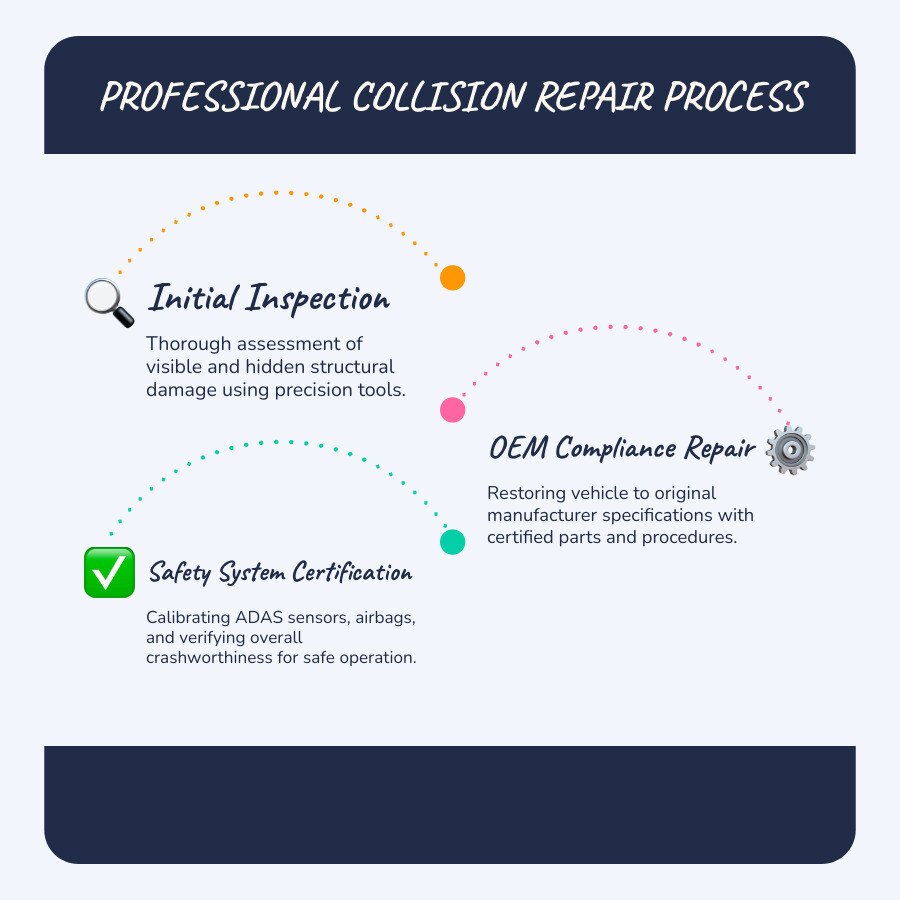
- Ensure OEM compliance — repairs match the original manufacturer’s specifications
- Provide forensic analysis — used in legal and insurance cases
- Train and audit repair shops — to maintain consistent quality
- Certify safety systems — including sensors, airbags, and advanced driver assistance systems
After a collision, most people just want their car fixed fast. That is completely understandable — especially when you are stressed, your family depends on the vehicle, and you are not sure who to trust.
But here is the problem: not all repairs are equal.
A rushed or under-qualified repair can leave hidden structural damage, miscalibrated safety sensors, or non-OEM parts that fail when you need them most. The stakes are high. Industry data shows forensic collision experts have handled thousands of cases where vehicles looked fine on the outside but were anything but safe underneath.
That is exactly why understanding professional repair standards matters — before you hand over your keys.
I’m William Dickinson, webmaster at Bob’s Lil Car Hospital, and I’ve spent over 20 years building online authority for businesses that connect people with trustworthy services — including vehicle collision experts who hold the industry to the highest standards. Read on to see what separates a true expert repair from a dangerous shortcut.
Defining the Role of Vehicle Collision Experts

When we talk about a vehicle collision expert, we aren’t just talking about someone who knows how to hammer out a dent. These professionals are the “scientists” of the automotive world. They provide specialized services that go far beyond basic aesthetics. Their primary goal is to ensure that a vehicle is returned to its pre-accident condition, specifically focusing on structural integrity and passenger safety.
A major part of their role involves diagnosing car problems that the untrained eye might miss. Modern cars are designed with “crumple zones.” These areas absorb energy during an impact. While the bumper might look fine, the frame rails or reinforcements behind it could be compromised. An expert uses precision tools to measure these components against original factory dimensions.
These specialists also act as a bridge between the repair shop and the manufacturer. Organizations like The SCRS – Society of Collision Repair Specialists work tirelessly to ensure shops have access to the latest repair data. Without this connection, a shop might use outdated methods that actually make the car less safe. Experts provide third-party audits and “roadmaps” for repairs, ensuring every bolt and weld meets Original Equipment Manufacturer (OEM) compliance.
Specialized Services Provided by Vehicle Collision Experts
The services provided by these experts are diverse. They often conduct on-site inspections for insurance companies or legal teams to determine the exact cause of a failure. For shop owners, they provide coaching and technical support to improve operational efficiency. At Bob’s Lil Car Hospital, we believe in honest fixes and transparency, and true experts mirror this commitment. They use digital measuring systems to prove a frame is straight within a fraction of a millimeter. This level of precision is the only way to guarantee the car will protect you in a second accident.
How Vehicle Collision Experts Address Emerging Safety Technologies
Cars are essentially rolling computers now. This shift has changed the job of vehicle collision experts entirely. They must now address Advanced Driver Assistance Systems (ADAS). These include lane-departure warnings, automatic braking, and adaptive cruise control.
New technologies, such as the Hyundai and Kia Vision Pulse technology, are designed to avoid obstacles in real-time. If a collision occurs, these sensors must be perfectly calibrated during the repair. If a sensor is off by even one degree, it might not “see” a pedestrian or another car in time. Collision experts stay ahead of these trends, ensuring that electronic safety systems perform exactly as the manufacturer intended.
The Science of Accident Reconstruction and Forensic Analysis
Sometimes, a repair isn’t just about fixing the car; it’s about finding out what happened. This is where Crash Reconstruction Expert Services come into play. These experts use physics and engineering to work backward from a crash scene. They analyze “crashworthiness”—how well the vehicle protected its occupants—and “occupant kinematics,” which is the study of how people move inside a car during an impact.
One of the most critical tools in this field is the Event Data Recorder (EDR), often called the car’s “black box.” Experts extract data to see speed, braking patterns, and throttle position in the seconds before impact. This evidence is vital for legal cases and insurance disputes.
| Feature | Standard Estimate | Forensic Analysis |
|---|---|---|
| Primary Goal | Assess visible damage | Determine cause/mechanics of crash |
| Tools Used | Visual inspection, estimating software | EDR imaging, 3D laser mapping, physics |
| Depth | Surface & structural damage | Mechanical failure & safety system analysis |
| Legal Standing | Used for insurance claims | Used as expert testimony in court |
Forensic mapping and mechanical failure analysis help identify if a part failed before the crash or because of it. This high-level analysis has been used in thousands of cases across the country to provide clarity in complex legal situations.
Why Professional Certifications and OEM Standards Matter
You wouldn’t want a surgeon who hasn’t been to medical school in decades, right? The same logic applies to your car. Professional certifications are the only way to know a technician is current on modern vehicle science. I-CAR Gold Class and ASE certifications are the gold standards in our industry. These programs require ongoing education because car technology changes every single year.
Following OEM standards is the only way to keep your car running strong and safe. When a manufacturer builds a car, they test it using specific parts and specific welding techniques. If a shop uses “alternative” parts or substandard materials, they are essentially experimenting with your safety.
Structural integrity is especially important with the rise of aluminum-bodied vehicles. Aluminum requires different tools and skills than traditional steel. An expert ensures that the refinish standards and structural bonds meet the factory requirements, maintaining the vehicle’s value and, more importantly, its safety.
Connecting with Industry Leaders and Networks
The collision repair world is a tight-knit community of professionals who advocate for better safety laws and better training. Groups like the Society of Collision Repair Specialists (SCRS) represent thousands of businesses. They recently welcomed back members like Intrepid Direct Insurance to help align insurance practices with modern repair needs.
There is also a huge push to bring new talent into the field. For example, the Carolinas Collision Association grants provide support to students to help them acquire the essential tools they need to start their careers. This investment ensures the next generation of vehicle collision experts is ready to handle the cars of tomorrow.
Whether you are looking for the best auto body shops in Kelso or anywhere in Southwest Washington, looking for these professional affiliations is a great way to vet a shop. These organizations stay on top of legislative updates, like bills in Georgia aimed at stopping insurance companies from “steering” customers toward low-quality, “preferred” shops.
Frequently Asked Questions about Collision Specialists
What qualifications should I look for in a vehicle collision expert?
You should look for I-CAR Gold Class or Platinum recognition and ASE (Automotive Service Excellence) certifications. A true expert should also have extensive experience with forensic evaluations and a deep understanding of OEM repair procedures. If they have been in the industry for decades, they likely have the “muscle memory” to spot hidden issues quickly.
How do experts ensure my car meets safety specifications?
They use a combination of digital measuring systems, manufacturer-specific repair manuals, and quality control checklists. After the structural work is done, they perform diagnostic scans to ensure all safety sensors are communicating correctly. Some experts even bring in third-party inspectors to verify the work before the car is returned to the owner.
What role does an event data recorder play in an investigation?
The EDR acts as an unbiased witness. It records technical data like vehicle speed, engine RPM, steering angle, and whether seatbelts were buckled. Vehicle collision experts use this data to create a forensic timeline of the crash, which can prove or disprove statements made by drivers involved in the accident.
Conclusion
At Bob’s Lil Car Hospital, we know that a car accident is one of the most stressful things you can go through. That is why we focus on exceptional care and professionalism. We believe you deserve to drive a vehicle that is just as safe as it was the day you bought it.
Don’t leave your safety to chance. If you’ve been in an accident or have concerns about a previous repair, call us today to ask any questions about your vehicle’s repair standards. We serve neighbors across Kelso, Longview, Castle Rock, and the surrounding areas with a commitment to putting your safety first. Visit our services page to learn more about how we can help you get back on the road with confidence.