

When Your Car’s Computer Needs Help
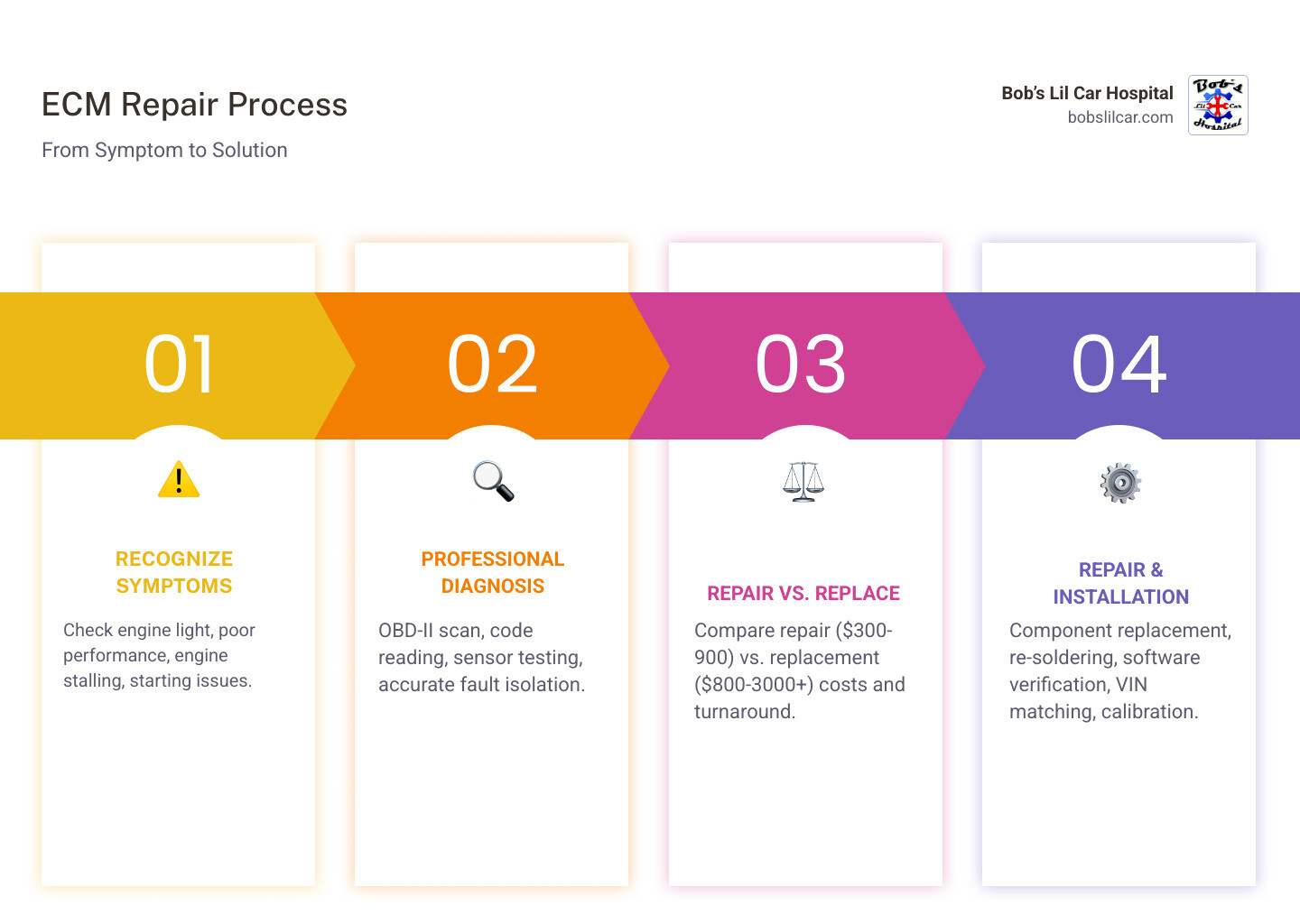
Engine control module repair is a specialized service that fixes or rebuilds the computer that controls your engine, typically costing between $300 and $900 for repairs or $800 to $3,000+ for replacement.
Quick answers about ECM repair:
- What it fixes: Engine stalling, check engine lights, poor performance, starting problems
- Repair cost: $300-$900 (takes 2-3 days)
- Replacement cost: $800-$1,500 (refurbished) or up to $3,000 (new OEM)
- DIY or professional? Best left to professionals due to specialized diagnostic tools and programming requirements
- Common causes: Electrical shorts, water damage, extreme temperatures, faulty sensors, corroded connections
Your car’s engine control module (ECM) is essentially a computer that runs your entire engine. It controls everything from fuel injection to ignition timing to emissions. When this critical component fails, the consequences can be serious – from being stranded on the road to failing emissions tests.
The good news? You have options. Repairing your existing ECM is often the most cost-effective choice, saving you hundreds or even thousands compared to replacement. The repair process involves testing the unit, replacing damaged components, re-soldering connections, and verifying the software still works correctly.
However, ECM issues aren’t always straightforward. Diagnosis requires specialized equipment to read diagnostic codes and rule out other problems that might be causing similar symptoms. That’s why professional help is crucial – incorrect diagnosis can lead to unnecessary repairs, and improper installation can damage your new or repaired module.
Your Car’s Brain: Understanding the Engine Control Module (ECM)
Imagine your car as a complex organism. While the engine is its heart, and the wheels are its legs, the Engine Control Module (ECM) is undeniably its brain. This sophisticated computer system is the central nervous system of your vehicle’s engine, constantly monitoring and regulating its performance. Without a properly functioning ECM, your car simply wouldn’t run, or at the very least, it would run very poorly.
The ECM’s primary role is to ensure your engine operates at peak efficiency, balancing power output with fuel economy and emissions control. It does this by taking in a constant stream of data from numerous sensors located throughout your engine. These sensors measure everything from the engine’s temperature and oxygen levels in the exhaust to the throttle position and crankshaft speed.
Once the ECM receives this data, it processes it in milliseconds, using pre-programmed maps and algorithms. Based on these calculations, it then sends precise commands to various actuators and components. This includes adjusting the fuel injection timing and quantity, optimizing ignition timing for each cylinder, controlling the idle speed, and managing emission control systems. This continuous feedback loop allows your car to adapt to changing driving conditions, ensuring smooth operation and compliance with environmental regulations.
Think of it this way: just like your brain interprets sensory input and sends commands to your muscles, the ECM interprets sensor data and sends commands to your engine’s components. It’s a marvel of modern automotive engineering, quietly working behind the scenes to keep you moving. For a deeper dive into how this critical component functions, you can explore resources like How the Engine Control Module Works.

What’s the Difference? ECM vs. ECU vs. PCM vs. TCU
The world of automotive electronics can sometimes feel like a bowl of alphabet soup, with many acronyms that sound similar but have distinct meanings. When talking about your car’s “brain,” you might hear terms like ECM, ECU, PCM, and TCU. While they all refer to electronic control units, understanding their specific roles can help clear up any confusion.
ECM (Engine Control Module):
This is the term we’ve been focusing on. The ECM specifically manages the engine and its associated systems. Its sole purpose is to optimize engine performance, fuel delivery, ignition, and emissions.
ECU (Engine Control Unit):
Often used interchangeably with ECM, ECU is a more general term for any electronic control unit in a vehicle. However, in common automotive parlance, “ECU” frequently refers specifically to the engine’s computer, making it synonymous with ECM.
PCM (Powertrain Control Module):
This is where things get a bit more comprehensive. A PCM is a combined unit that controls both the engine (like an ECM/ECU) and the transmission. In vehicles with a PCM, a single computer handles the intricate coordination between engine power output and gear shifting, ensuring seamless operation of the entire powertrain.
TCU (Transmission Control Unit) / TCM (Transmission Control Module):
As the name suggests, a TCU or TCM specifically manages the automatic or semi-automatic transmission system. It monitors factors like vehicle speed, throttle position, and engine load to determine the optimal gear selection and shift points. If a vehicle has a separate ECM and TCU, these two modules communicate closely to ensure harmonious performance.
So, while ECM and ECU generally refer to the engine’s computer, a PCM integrates both engine and transmission control into one unit. A TCU/TCM, on the other hand, is dedicated solely to the transmission. We often use “ECM” as a general term because it’s the core component responsible for the engine’s function, regardless of whether it’s part of a larger PCM or a standalone unit. Understanding these distinctions is crucial, especially when diagnosing issues, as a problem with shifting might point to a TCU, while engine performance issues are often rooted in the ECM or PCM.
Is Your ECM Failing? Key Symptoms and Common Causes
When your car’s brain starts to malfunction, it can manifest in a variety of unsettling ways. Recognizing the symptoms of a failing ECM is the first step toward getting your vehicle back on track. Just like any complex electronic device, ECMs aren’t immune to failure, and several factors can contribute to their demise. At Bob’s Lil Car Hospital, we see these issues regularly in vehicles across Kelso, Longview, Kalama, Castle Rock, and Toutle, WA. Addressing these symptoms promptly is key to preventing more extensive and costly repairs down the road. For general automotive repair guidance, you can always visit our autorepair section.

Telltale Signs of a Faulty ECM
A failing ECM can lead to a wide range of frustrating and potentially dangerous problems. Here are some of the most common symptoms we encounter:
Check Engine Light Illumination:
This is perhaps the most obvious sign. The orange engine symbol on your dashboard is the ECM’s way of telling you something is wrong. While it can indicate many issues, it’s a definite call for investigation.
Poor Engine Performance:
Your car might experience a noticeable loss of power, hesitation during acceleration, or a general sluggishness. The engine may struggle to maintain speed or respond slowly to throttle input.
Engine Stalling or Misfiring:
The engine might suddenly cut out while driving, or it could misfire, causing a rough idle and a shaky ride. This is often due to the ECM sending incorrect signals for fuel delivery or ignition.
Inconsistent Idle:
The engine might idle too high, too low, or fluctuate erratically. This often indicates the ECM is having trouble regulating the air-to-fuel mixture or idle control valve.
Failure to Start:
If your car cranks but won’t turn over, or simply won’t start at all, a faulty ECM could be the culprit. It might not be sending the necessary signals to the fuel pump or ignition system.
Reduced Fuel Economy:
An ECM that isn’t optimizing the air-to-fuel ratio can cause your engine to burn more fuel than necessary, leading to a noticeable drop in gas mileage.
Failed Emissions Test:
Because the ECM plays a critical role in managing emission control systems, a malfunctioning unit can cause your vehicle to produce higher levels of pollutants, resulting in a failed emissions test.
If you’re experiencing any of these issues, especially in combination, it’s a strong indicator that your ECM needs professional attention.
What Causes an ECM to Go Bad?
ECMs are built to be robust, but they are still electronic components operating in a harsh automotive environment. Several factors can contribute to their failure:
Electrical Issues:
Short circuits in the wiring harness, voltage spikes, or even incorrect battery installation can overload and damage the delicate circuits within the ECM. We’ve seen cases where a simple mistake during battery replacement can destroy the module.
Water Damage:
While ECMs are typically sealed, water intrusion due to a leaky cowl, flood damage, or even prolonged exposure to high humidity can corro corrode internal components or create short circuits.
Extreme Temperatures:
Prolonged exposure to very high or very low temperatures can cause the electronic components on the circuit board to expand and contract, leading to cracked solder joints or component failure over time.
Vibration Damage:
Constant vibration from driving on rough roads can loosen connections or crack the internal components of the ECM, especially if it’s not securely mounted.
Corroded Connections:
The connectors that link the ECM to the vehicle’s wiring harness can corrode due to moisture or contaminants, leading to poor electrical contact and intermittent signals.
Faulty Sensors or Actuators:
Sometimes, the ECM itself isn’t the primary failure. A consistently faulty sensor or actuator sending incorrect signals can cause the ECM to overwork or react improperly, eventually leading to its own failure. For instance, a shorted Idle Air Control Valve (IACV) is known to burn out certain ECMs.
Age and Wear:
Like any electronic component, ECMs have a lifespan. Over many years and miles, components can simply wear out or degrade.
Software Glitches:
Less common, but sometimes internal software corruption or bugs can cause the ECM to malfunction, even if the hardware is physically sound.
Understanding these causes helps us diagnose the root of the problem accurately, ensuring that any repair or replacement is a lasting solution for our customers across Southwest Washington.
The Big Decision: Engine Control Module Repair vs. Replacement
Once a faulty ECM has been identified, the next big question is: should we repair it or replace it? This decision often boils down to a balance of cost, long-term reliability, and turnaround time. Both options have their merits, and at Bob’s Lil Car Hospital, we’re here to guide you through the best choice for your vehicle and your budget. This is a common discussion we have with our customers seeking auto repair and car maintenance services.
Breaking Down the Costs
The financial aspect is usually a significant factor in deciding between ECM repair and replacement. Here’s a general breakdown of what you can expect:
| Option | Estimated Cost Range | Labor Cost (Avg.) | Parts Cost (Avg.) | Turnaround Time | Notes |
|---|---|---|---|---|---|
| ECM Repair | $300 – $900 | Included | Included | 2-3 days | Cost-effective, environmentally friendly, and repairs existing units. |
| Remanufactured ECM | $800 – $1,500 | $77 – $97 | $932 – $984 | Varies | Refurbished units often include the latest software, typically $600 less than dealer parts. |
| New OEM ECM | Up to $3,000 (parts only) | $77 – $97 | $932 – $984+ | Varies | Highest cost, guaranteed new part, often requires programming. |
| Total Replacement | $1,010 – $1,081 (average total) | $77 – $97 | $932 – $984 | 1-3 days | Includes labor and parts for a typical replacement. |
Please note: These are average estimates. Actual costs can vary based on your vehicle’s make, model, the specific damage, and market prices in our Southwest Washington service areas.
As you can see, repairing your existing ECM is often the most budget-friendly option. It can save you hundreds, sometimes even thousands, compared to purchasing a brand-new OEM part. This choice is not only good for your wallet but also for the environment, as it reduces electronic waste.
Remanufactured ECMs offer a middle-ground solution. These are used units that have been thoroughly tested, repaired, and updated to meet or exceed original equipment (OE) specifications. They often come pre-programmed for your vehicle’s VIN, making them a “plug and play” option that can still be significantly cheaper than a new OEM part. For instance, a high-quality VIN-matched replacement ECU/ECM is typically $600 less than dealer-installed parts.
While a new OEM ECM guarantees a fresh start with manufacturer-backed quality, its high cost often makes it a last resort, especially when a reliable repair or remanufactured option is available.
The Process of Engine Control Module Repair and Rebuilding
When we talk about engine control module repair or rebuilding, we’re referring to a meticulous process designed to restore your existing unit to full functionality. This isn’t a quick fix but a detailed service performed by skilled technicians.
Here’s a general overview of the process:
Initial Testing and Diagnosis:
The first step involves comprehensive testing of the faulty ECM. We connect it to specialized diagnostic equipment to identify the specific components or circuits that have failed. This bench testing allows us to pinpoint issues that might not be obvious during vehicle-level diagnostics.
Disassembly and Inspection:
Once the fault is identified, the ECM is carefully disassembled. Our technicians visually inspect the circuit board for signs of damage, such as burnt components, cracked solder joints, or corrosion.
Component Replacement:
Any identified faulty components, such as microprocessors, capacitors, resistors, or drivers, are carefully replaced with new, high-quality parts. This ensures the longevity and reliability of the repair.
Re-soldering and Circuit Repair:
Weak or cracked solder joints, a common issue due to heat and vibration, are expertly re-soldered. Any damaged traces or circuits on the board are repaired to ensure proper electrical pathways.
Software Check and Update:
While the hardware is being repaired, we also verify the integrity of the ECM’s internal software. If necessary, and depending on the unit, the latest OEM software updates can be flashed to the module, ensuring it operates with the most current programming for your specific vehicle. This is particularly relevant for remanufactured units, which often include the latest software.
Final Testing and Quality Assurance:
After all repairs are completed, the ECM undergoes rigorous final testing. It’s often bench-tested under simulated operating conditions to ensure all functions are restored and stable. For some units, on-car vehicle validation might also be performed to test durability and performance.
Return to Service:
Once the ECM passes all tests, it’s ready to be returned to your vehicle. For many reputable repair services, the typical turnaround time for testing and rebuilding an ECM is approximately 2-3 working days. This efficiency means you’ll have your vehicle back on the roads of Longview, Kelso, or Castle Rock sooner.
The goal of this process, whether it’s a repair or a remanufacture, is to provide a reliable and cost-effective alternative to buying a brand-new unit.
Diagnosis and Installation: A Job for the Pros
While the idea of tackling a car repair yourself can be appealing, when it comes to your ECM, it’s a job best left to the professionals. The complexity of modern vehicle electronics, the need for specialized diagnostic tools, and the critical role the ECM plays mean that DIY attempts can often lead to more problems and higher costs down the line. At Bob’s Lil Car Hospital, our certified technicians in Southwest Washington are equipped with the expertise and tools necessary for accurate diagnosis and precise installation. We are committed to providing quality automotive repairs for our community.
How Professionals Diagnose a Faulty ECM
Diagnosing an ECM issue isn’t as simple as plugging in a device and getting a clear “ECM is bad” message. It requires a systematic approach to rule out other potential problems that might mimic ECM failure symptoms. Here’s how our professionals approach it:
Initial Scan with an OBD-II Scanner:
The first step is always to connect an OBD-II (On-Board Diagnostics II) scanner to your vehicle’s diagnostic port. This tool retrieves Diagnostic Trouble Codes (DTCs) stored by the ECM. These codes provide valuable clues about which system or component might be malfunctioning.
Ruling Out Other Issues:
It’s crucial to remember that a “Check Engine” light or poor engine performance doesn’t automatically mean the ECM is at fault. The symptoms of a failing ECM can often overlap with issues in other components like sensors, wiring harnesses, fuel pumps, or ignition coils. Our technicians carefully test these related systems to ensure the problem isn’t elsewhere. For instance, a persistent ‘check engine’ light might be due to a loose fuel cap rather than an ECM issue.
Sensor Testing and Data Analysis:
We use advanced diagnostic tools to monitor live data from various engine sensors. By comparing these real-time readings against the manufacturer’s technical specifications, we can identify if sensors are sending incorrect data to the ECM or if the ECM is misinterpreting correct data.
Wiring and Connection Inspection:
A thorough visual inspection and electrical testing of the ECM’s wiring harness and connectors are performed. Loose, corroded, or damaged wires can disrupt communication to and from the ECM, leading to performance issues. A voltage drop test can also help uncover many potential ECM problems related to power supply.
Bench Testing (if ECM removal is necessary):
If initial diagnostics strongly point to the ECM, and after ruling out all other possibilities, the module might be removed for specialized bench testing. This allows for a more in-depth analysis of the ECM’s internal circuits and processing capabilities, confirming whether the unit itself has failed.
This comprehensive diagnostic process ensures that we accurately identify the root cause of your vehicle’s problems, saving you time and money by avoiding unnecessary repairs.
Why Professional Engine Control Module Repair and Installation is Crucial
Attempting to replace or reprogram an ECM yourself without the proper tools and knowledge can lead to frustration and potentially more damage. Here’s why professional intervention is essential:
Specialized Tools and Expertise:
Modern ECMs require sophisticated diagnostic equipment and programming tools. Our technicians have access to these specialized devices and are trained to interpret the complex data they provide.
Reprogramming and VIN Matching:
When a new or remanufactured ECM is installed, it often needs to be programmed or “flashed” with the correct software for your specific vehicle’s year, make, model, and Vehicle Identification Number (VIN). This ensures the ECM communicates correctly with all other vehicle systems. Without proper VIN matching and programming, the new ECM simply won’t work, or it could cause other systems to malfunction.
Calibration:
Beyond basic programming, some ECMs require specific calibration procedures to optimize their performance with your engine. This ensures accurate fuel delivery, ignition timing, and emission control. Calibration is one of the trickiest parts of dealing with a faulty ECM.
Preventing Further Damage:
Incorrect installation or programming can cause immediate damage to the new ECM or other sensitive electronic components in your vehicle. For example, failing to address the underlying cause of the original ECM failure (like a shorted IACV) before installing a new unit will likely lead to the new ECM failing as well. Professionals understand these precautions and perform necessary related repairs.
Warranty and Reliability:
Professional installation often comes with a warranty on both parts and labor, providing you with peace of mind. This isn’t something you get with a DIY attempt.
Time and Efficiency:
While the diagnostic process can be complex, professional services are typically much faster and more efficient than a DIYer struggling with unfamiliar technology.
In short, while you might be able to physically swap out an ECM, making it function correctly within your vehicle’s intricate network requires professional expertise. We have the experience and equipment to handle these complex repairs right here in Kelso, Longview, Kalama, Castle Rock, and Toutle, WA.
Your Trusted Partner for Complex Car Repairs
If you’re experiencing any of these symptoms, it’s crucial not to wait. Ignoring a potential ECM issue can lead to more significant engine damage and leave you stranded. At Bob’s Lil Car Hospital, we combine expert diagnostics with genuine care to solve your car’s most complex problems. Our technicians have the tools and experience to accurately diagnose and resolve your ECM issues. This keeps your car running strong. Don’t let a computer glitch take your car off the road. Call us today to schedule an appointment and experience the peace of mind that comes with professional, caring service.